A 6-mm Implant Is Not a Shortcut: What 10 Years of Evidence Actually Show

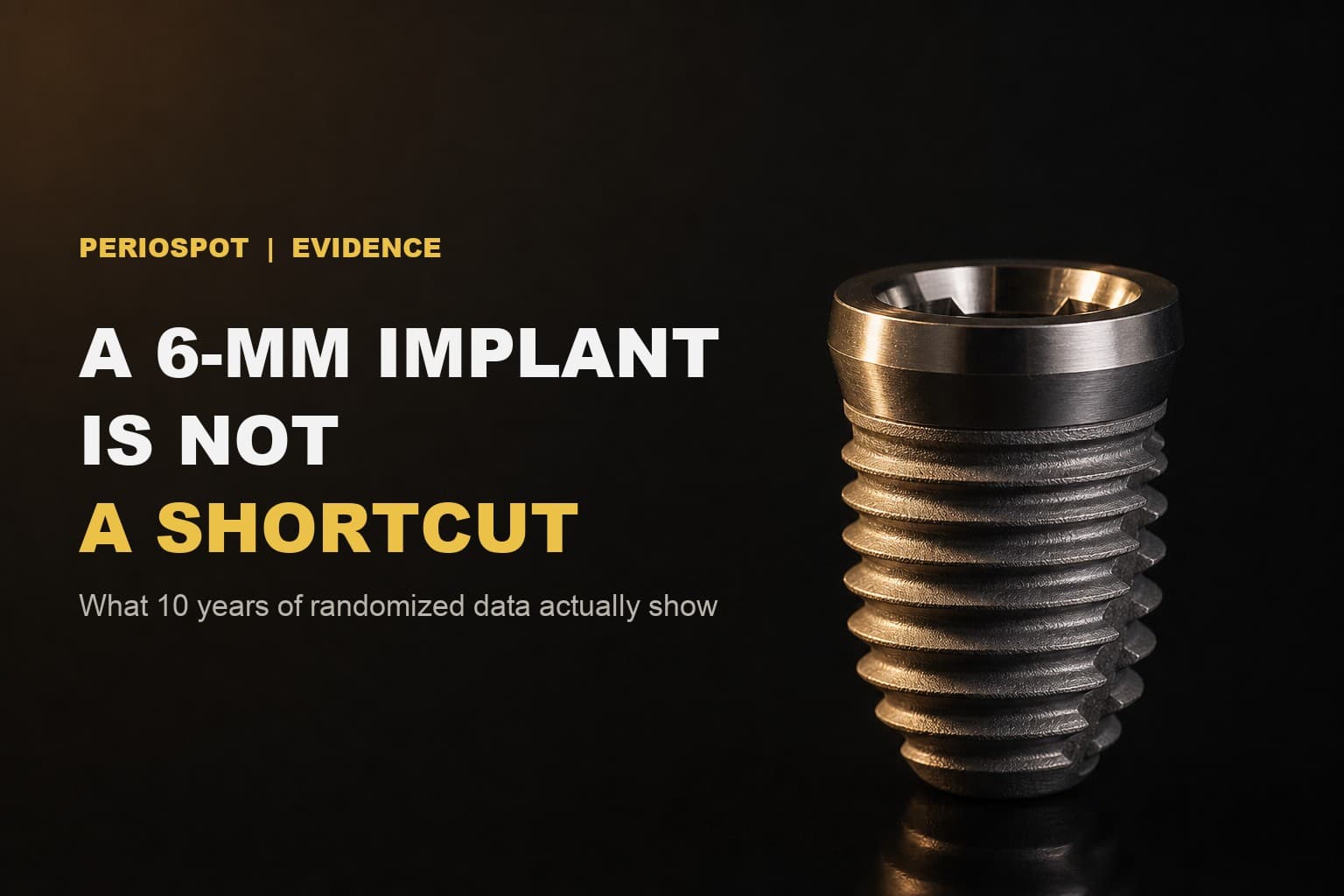
Table of Contents
A 6-mm implant instead of a sinus lift is not an improvisation. In the randomized trial with the longest follow-up we have, patients who received 6-mm implants in the atrophic posterior maxilla reached 96.0 percent implant survival at 10 years, against 100 percent for longer implants placed with simultaneous sinus grafting. That difference was not statistically significant, although a trial this size cannot formally prove the two approaches equivalent. The short-implant patients also spent 22 fewer minutes in surgery and, at the trial's own prices, paid roughly half as much. None of that makes a 6-mm implant a shortcut. It is a different protocol with its own entry criteria, and the moment you ignore them, the evidence stops backing you up.
A few days ago I published a short video saying exactly that sentence: a 6-mm implant is not a shortcut. It became that week's most engaged content on every channel where I published it, which tells me the topic hits a nerve. So this article is the long version: what the trials actually measured, what the numbers say, and, more importantly, the rules that were baked into those trials and quietly disappear when we retell the story at a study club.
The trial that answers the question
Most of the numbers above come from one remarkable study: a multicenter randomized controlled trial run across centers in Zurich, Vienna, Szczecin, Santiago de Compostela and Connecticut. The design was simple and honest. One hundred and one patients, all missing teeth in the posterior maxilla, all with a residual ridge height of 5 to 7 millimeters below the sinus floor. Half were randomized to 6-mm implants placed in native bone. The other half received 11 to 15-mm implants placed simultaneously with a lateral window sinus lift. Everyone was restored with single crowns, then followed for a decade.
The team published results at 1 year, 3 years, and finally the 10-year data in the Journal of Clinical Periodontology in 2024. Here is the survival story over time.
Implant survival, 6-mm versus longer implant plus sinus lift
Same randomized cohort at each time point. 137 implants placed in 101 patients; 77 patients with 105 implants contributed data across the 5-to-10-year window (21% drop-out).
Two implants lost over ten years, in one arm, out of a hundred patients, in a trial too small to declare the arms equal. What the numbers do pin down is where the certain costs sit: the grafted group reached its perfect record through an added simultaneous grafting procedure, with the extra operative time, morbidity and money that carries.
What the sinus lift actually costs the patient
I place implants and I do sinus lifts, and I want to be fair to both. The lateral window sinus lift is one of the best documented procedures in implant dentistry; I wrote a whole article on choosing between the lateral window and the transcrestal approach. The honest comparison is not "graft bad, short good". It is: what does the graft buy you, and what does it cost, in a site where a 6-mm implant would also work?
The price of the graft in the same randomized cohort
6-mm implant in gold, longer implant plus sinus lift in grey or red
The morbidity signal goes beyond this single trial. A 2019 systematic review and meta-analysis of seven RCTs found that going short meant significantly fewer post-surgical reactions, and about a ninth of the risk on the scariest line item: the risk ratio for sinus perforation or infection was 0.11 (95% CI 0.02 to 0.63) compared with sinus floor elevation. You cannot perforate a membrane you never lifted.
Patients feel this difference. The 1-year report of the trial, which tracked quality-of-life scores (OHIP-49) through the healing phase, concluded that short implants were more favorable for short-term patient morbidity, treatment time and price. Ten years later, the OHIP scores of the two groups were statistically indistinguishable. Which is exactly the point: same destination, gentler road.
The bigger evidence picture
One trial, even a good one, is one trial. So let me stack the rest of the pile on the table.
The University of Michigan group meta-analyzed 18 RCTs with 1,612 implants in 2019: no survival difference at 1 or 3 years between extra-short (6 mm or less) and long (10 mm or more) implants, with less marginal bone loss, fewer biological complications, shorter surgical time and lower cost on the short side. The trade they flagged went the other way for prosthetics, where complications tended to favor the longer implants. Short implants carry taller crowns, and porcelain does not read meta-analyses.
In 2024 an updated systematic review with trial sequential analysis, now 19 RCTs and 2,214 implants, graded the certainty of all of it. The conclusion is worth quoting almost verbatim because it draws the exact boundary of what we know: based on moderate to high certainty evidence, 6-mm implants may be used as an alternative to sinus lift, and implants of 6 mm or less perform like standard implants in native bone and full-arch cases in either jaw. For everything else, the evidence is inconclusive or insufficient.
The ten-year layer deserves its own honest paragraph, because it grew between 2023 and 2026 and it is not one-sided. A second randomized trial in the posterior maxilla, from the Groningen group, followed single crowns on 6-mm implants against 11-mm implants with sinus augmentation for a decade: survival 89.5 versus 90.9 percent in a very small sample of 41 implants, with stable bone and happy patients in both arms. The Zurich single-crown trial I cite below for its reassuring 3-year results also published a 10-year update, in native posterior bone rather than sinus territory: 85.7 percent for 6-mm implants versus 97.1 percent for 10-mm implants, p = .072, with most losses in the mandible as late, non-inflammatory losses of osseointegration. And a 2026 pooled analysis of all ten-year data on implants of 6 mm or less estimated 91.2 percent patient-level survival overall, while its paired analysis of four RCTs found slightly lower ten-year survival than standard implants, risk ratio 0.920 (95% CI 0.857 to 0.987). That pooled picture mixes jaws and indications, so it does not overturn the maxilla-specific trials above. What it does retire is any claim that ten-year equivalence is settled. Through five years the data are solid; at ten they are encouraging in the sinus-lift scenario and genuinely mixed outside it.
EVIDENCE SAYS YES
A 6-mm implant in the posterior maxilla with 5 to 7 mm of residual ridge, instead of a sinus lift with a longer implant. Moderate to high certainty at 5 years; two small RCTs out to 10 found no clear difference.
EVIDENCE SAYS NOT YET
Declaring formal ten-year equivalence; extrapolating to 4-mm and 5-mm "ultrashort" implants as sinus lift replacements; or replacing vertical ridge augmentation in the atrophic mandible with short implants. Inconclusive or insufficient data.
EVIDENCE SAYS NO
Treating the 6-mm implant as a rescue for sites the trials never included: ridges under 5 mm, no maintenance program, no attention to the prosthetic design. That is not the protocol that produced 96 percent at 10 years.
And because I promised honesty: the 2018 ITI Consensus Conference looked at the same literature and kept one caveat that deserves to survive every retelling. Across studies, short implants showed survival ranging from 86.7 to 100 percent, against 95 to 100 percent for standard implants, with a failure risk ratio of 1.24 that was not statistically significant but came with a wide confidence interval. Their wording was precise: short implants are a valid option to avoid augmentation morbidity, however they reveal a higher variability and lower predictability in survival rates. My plain-language reading of that spread, and it is an interpretation rather than a trial result: when short implants are done well they match long ones, but the distance between well and badly done is wider. The protocol is less forgiving. That is the opposite of a shortcut.
The rules that make 6 mm work
If you strip the trials down to their inclusion criteria and methods, the "rules" of the 6-mm protocol write themselves. Remember what those trials actually were: delayed loading, single crowns, one implant system per trial, experienced surgical centers, and structured maintenance for a decade. The further your case drifts from that recipe, the less these numbers apply. This is the part I wish fit into a 60-second video.
1. Measure, do not eyeball
The randomized evidence lives at 5 to 7 mm of residual ridge height below the sinus. Above that, you often do not need the discussion. Below 5 mm, you have left the evidence base for flapless swaps and grafting remains the documented path.
2. Respect primary stability in soft maxillary bone
A 6-mm implant gives you no apical reserve. Posterior maxillary bone is often D3 or D4, so plan the osteotomy for stability rather than speed and be ready to walk away from an implant that does not lock.
3. Design the prosthetics before the surgery
Short implant, tall crown: the crown-to-implant ratio rises and the meta-analyses show the complication trade shifts toward prosthetics. Screw-retained where possible, controlled occlusal scheme, and consider splinting adjacent short implants.
4. Put the patient in a maintenance program
With 6 mm of bone anchorage, the marginal bone is most of the bone. The trial patients were recalled regularly for a decade. If your practice cannot offer that, you are running a different experiment than the one that produced these numbers. My article on diagnosing the defect before treating peri-implantitis covers what to do when recall finds trouble.
The 60-second version
This is the video that started the conversation. If the article is the textbook chapter, this is the elevator pitch.
A 6-mm implant is not a shortcut. One minute, one argument, the same numbers as this article.
What I tell patients, and what I tell colleagues
To a patient with 6 mm of bone under a healthy sinus, I now say something like this: "There are two well studied ways to do this. One rebuilds bone inside your sinus during the same surgery and uses a standard implant; it works very well and adds a grafting step. The other uses a shorter implant in the bone you already have; studies following patients for up to ten years have found no clear difference in outcomes for cases like yours, with less surgery, a faster recovery and lower cost. Both are legitimate. Here is why I lean toward one for you." That last sentence matters, because the lean changes with the anatomy, the neighboring teeth, the patient's tolerance for surgery, and my honest read of my own primary-stability chances.
To colleagues, my message is the one from the video, expanded by one clause. A 6-mm implant is not a shortcut; it is a documented protocol with entry criteria, and the discipline is in the criteria. The moment "short implants work" becomes "I never need to graft again", we have replaced one dogma with another. The sinus lift did not become a bad operation in 2024. It became one of two good answers for a specific site, and our job is matching the answer to the site instead of to our habits.
The one-line summary: in the posterior maxilla with 5 to 7 mm of ridge height, a 6-mm implant with a single crown is supported by moderate to high certainty evidence as an alternative to sinus lift with a longer implant: no statistically clear survival difference out to 10 years in two small randomized trials, fewer surgical and sinus complications, less chair time and lower cost at trial prices. Formal long-term noninferiority has not been established, and outside those boundaries the evidence thins fast. There, the honest word is "unknown", not "works".
Frequently asked questions
Are 6-mm implants as good as regular implants with a sinus lift?
In the right site, the randomized data are reassuring. The two trials that reached 10 years in the posterior maxilla with 5 to 7 mm of residual ridge found no significant survival difference (96.0 versus 100 percent in one, 89.5 versus 90.9 percent in the other), with shorter surgery, fewer surgical complications and lower cost for the 6-mm option. Certainty is moderate to high at 5 years; both 10-year trials are small, so formal long-term equivalence is not proven.
How much bone do you need for a 6-mm implant?
The trials behind these numbers enrolled patients with 5 to 7 mm of residual ridge height below the sinus. A 6-mm implant also needs enough ridge width for its diameter, and the safety margin to the sinus floor still applies. Below roughly 5 mm of height, the randomized evidence for skipping the graft runs out.
Do short implants fail more often?
At 1 to 5 years, meta-analyses of randomized trials show no survival difference against longer implants with augmentation. At 10 years the picture is more nuanced: a 2026 pooled analysis of four RCTs across mixed indications found slightly lower survival for short implants (risk ratio 0.920 at patient level), and the Zurich native-bone trial reported 85.7 versus 97.1 percent (p = .072), with losses concentrated in the mandible. The 2018 ITI consensus flagged the same theme as higher variability across studies (survival 86.7 to 100 percent): the technique is less forgiving of poor case selection and execution, even though its best results match standard implants.
Are 4-mm ultrashort implants also an alternative to sinus lift?
Not with today's evidence. The 2024 systematic review that supports 6-mm implants as a sinus lift alternative explicitly found the data for 4-mm and 5-mm implants in that role inconclusive or insufficient. The 6-mm conclusion does not automatically transfer to shorter lengths.

Go deeper on implant treatment planning
If this decision framework is useful, two resources pair well with it. My speaker pack How to Solve the More Common Bone Defects in Implant Dentistry covers the augmentation side of the equation, ready to present. And for the shelf, Misch's Contemporary Implant Dentistry (fourth edition, edited by Randolph Resnik) remains the deepest single reference on treatment planning fundamentals, including crown-to-implant ratio and bone density protocols.
Get the Misch textbookDisclosure: the book link is a geo-targeted affiliate link. If you buy through it, Periospot earns a small commission at no extra cost to you. It helps keep articles like this one free.
Thoma DS, Haas R, Sporniak-Tutak K, et al. Randomized controlled multi-centre study comparing shorter dental implants (6 mm) to longer dental implants (11-15 mm) in combination with sinus floor elevation procedures: 10-year data. J Clin Periodontol. 2024;51(4):499-509. doi:10.1111/jcpe.13954 · PMID 38296249
Thoma DS, Haas R, Tutak M, et al. Part 1: demographics and patient-reported outcomes at 1 year of loading. J Clin Periodontol. 2015;42(1):72-80. doi:10.1111/jcpe.12323 · PMID 25418606
Pohl V, Thoma DS, Sporniak-Tutak K, et al. 3-year results from a multicentre, randomized, controlled clinical trial. J Clin Periodontol. 2017;44(4):438-445. doi:10.1111/jcpe.12694 · PMID 28081288
Ravidá A, Wang IC, Barootchi S, et al. Meta-analysis of randomized clinical trials comparing clinical and patient-reported outcomes between extra-short (≤6 mm) and longer (≥10 mm) implants. J Clin Periodontol. 2019;46(1):118-142. doi:10.1111/jcpe.13026 · PMID 30362137
Yan Q, Wu X, Su M, Hua F, Shi B. Short implants (≤6 mm) versus longer implants with sinus floor elevation in atrophic posterior maxilla: a systematic review and meta-analysis. BMJ Open. 2019;9(10):e029826. doi:10.1136/bmjopen-2019-029826 · PMID 31662363
Ravidá A, Serroni M, Borgnakke WS, et al. Short (≤6 mm) compared with ≥10-mm dental implants in different clinical scenarios: systematic review of RCTs with meta-analysis, trial sequential analysis and quality of evidence grading. J Clin Periodontol. 2024;51(7):936-965. doi:10.1111/jcpe.13981 · PMID 38764386
Guljé FL, Raghoebar GM, Gareb B, Vissink A, Meijer HJA. Single crowns in the posterior maxilla supported by either 11-mm long implants with sinus floor augmentation or by 6-mm long implants: a 10-year randomized controlled trial. Clin Oral Implants Res. 2024;35(1):89-100. doi:10.1111/clr.14200 · PMID 37941089
Sahrmann P, Naenni N, Jung RE, Hämmerle CHF, Attin T, Schmidlin PR. Ten-year performance of posterior 6-mm implants with single-tooth restorations: a randomized controlled trial. J Dent Res. 2023;102(9):1015-1021. doi:10.1177/00220345231170538 · PMID 37387401
Lin L, Ren Y, Zhu E, Wang X, Yao Q. Ten-year outcomes of short dental implants (≤6 mm): a systematic review and sensitivity meta-analysis. BMC Oral Health. 2026. doi:10.1186/s12903-026-08742-4 · PMID 42226287
Jung RE, Al-Nawas B, Araujo M, et al. Group 1 ITI Consensus Report: the influence of implant length and design and medications on clinical and patient-reported outcomes. Clin Oral Implants Res. 2018;29(Suppl 16):69-77. doi:10.1111/clr.13342 · PMID 30328189
Sahrmann P, Naenni N, Jung RE, et al. Success of 6-mm implants with single-tooth restorations: a 3-year randomized controlled clinical trial. J Dent Res. 2016;95(6):623-628. doi:10.1177/0022034516633432 · PMID 26917439
Check Your Knowledge
Comments
0 totalLoading comments...
Previous
25 years of implant follow-up: 94 percent survived, 14 percent met the health definition
Next
Gum Disease and High Blood Pressure: What the Evidence Actually Shows
Related Articles
25 years of implant follow-up: 94 percent survived, 14 percent met the health definition
13 min read
Machine Learning for Dentists: Predicting Implant Success with AI
1 min read