25 years of implant follow-up: 94 percent survived, 14 percent met the health definition

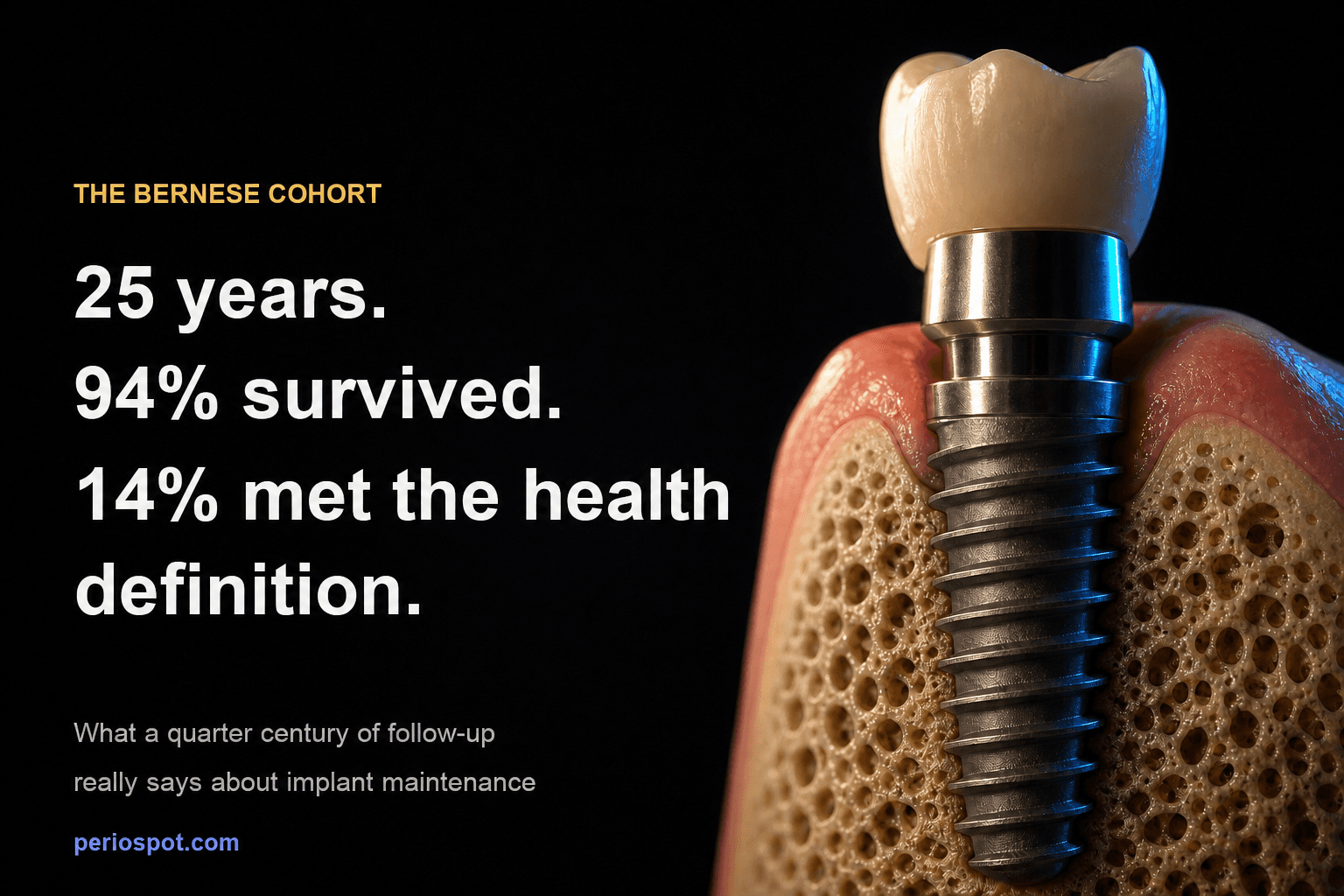
Table of Contents
Among 252 implants included at the twenty-five-year follow-up, 94.0 percent had survived. That is the number that travelled around dentistry this month, and it deserves attention. But survival was not the same as peri-implant health: among 243 implants classifiable for peri-implant condition, 14.4 percent met the study's health definition.
Both numbers come from the 25-year results of the Bernese prospective cohort, published this year in Clinical Implant Dentistry and Related Research. It is one of the longest prospective follow-ups we have on tissue-level implants. Reading only the survival line is how our profession keeps telling patients a story that is technically true and clinically incomplete.
What the cohort actually is
Partially edentulous patients restored with tissue-level implant-supported prostheses at the University of Bern, examined by calibrated examiners with clinical and radiographic assessment. At 10 years, 303 patients and 511 implants were included; 300 patients and 508 implants were classifiable for peri-implant condition. At 25 years, 159 patients and 252 implants were included; 155 patients and 243 implants were classifiable.
Those totals carry more weight than they look. Between the examinations, patient attrition was 47.5 percent (144/303) and implant attrition was 50.7 percent (259/511). Among the 144 patients lost during this interval, 22 had died, 9 were ill, 24 lived too far away, 54 could not be reached, and 35 declined. The 25-year column is therefore a smaller retained sample, and every percentage below has to be read with that in mind.
The two curves that move in opposite directions
What changed between year 10 and year 25
Implant level. Survival and success use the included samples (511 implants at 10 years; 252 at 25 years); condition prevalence uses the classifiable samples (508 and 243).
The observed implant-failure proportion was 1.2 percent at 10 years and 6.0 percent at 25 years. Nine of the 15 failures accounted for at 25 years were losses of osseointegration, all at premolar or molar sites.
Why 91 percent success can sit next to 14 percent health
This looks like a contradiction until you read the definitions, and it is the most useful thing in the paper.
Success, in this cohort, meant four things: no persistent complaints such as pain or dysesthesia, no infection with suppuration, no mobility, and no continuous radiolucency around the implant. Notice what is not on that list. Nothing about bleeding. Nothing about inflammation. An implant with bleeding or inflammation but without persistent complaints, suppurative infection, mobility, or continuous radiolucency could still meet this study's success criteria.
Peri-implant health is a stricter idea: no clinical signs of inflammation, no more than one spot of bleeding on probing, no suppuration, and no bone loss beyond initial remodelling.
So the two numbers are not in conflict. They are answering different questions. Success asks whether the implant is still doing its job. Health asks whether the tissue around it is quiet. At 25 years, 90.8 percent met the study's success criteria, while 14.4 percent of the separate classifiable implant sample met the health definition.
Mucositis fell and peri-implantitis rose. What does that actually mean?
Here is where it is very easy, and very tempting, to say something the data cannot support. I will show you the trap first, because I walked into it myself when I first wrote this article.
Mucositis prevalence falls from 82.1 to 76.5 percent while peri-implantitis climbs from 3.5 to 9.1 percent. The decrease in one is 5.6 points and the increase in the other is 5.6 points. It is deeply tempting to conclude that those lesions converted, one for one.
That reasoning is circular, and here is why. Within each classifiable cross-section, the three states are mutually exclusive and sum to 100 percent. Peri-implant health did not change (14.4 percent at both visits). If health is fixed and the total is fixed, then any fall in mucositis is arithmetically forced to equal the rise in peri-implantitis. The matching 5.6 is a property of percentages, not a discovery about disease.
The counts underneath make the limitation clearer. Implant-level peri-implantitis was 18/508 at 10 years and 22/243 at 25 years. At patient level it was 30/300 and 28/155. The numerator was similar while the classifiable denominator was much smaller, but these cross-sectional counts do not show which individuals improved, progressed, or were newly diagnosed.
Patient-level peri-implantitis in each classifiable sample
Same cohort, different retained samples; not a transition analysis
And critically, the study reports two cross-sectional snapshots. It does not report an implant-by-implant transition matrix or a time-to-event analysis, so it cannot tell us how many mucositis lesions became peri-implantitis, or how many resolved, or how many were newly diagnosed in implants that were healthy before.
What it does support is narrower and still worth knowing: peri-implantitis prevalence was higher in the classifiable 25-year implant sample than in the classifiable 10-year sample, and mucositis remained highly prevalent throughout. Note also that the fall in mucositis was not statistically significant (p = 0.08 at implant level, p = 0.06 at patient level), so the honest reading is that mucositis stayed stubbornly common rather than that it improved.
The clinical reason to identify and manage mucositis comes from EFP guidance, not from a conversion analysis in this cohort.
The two variables associated with disease
In the analysis of what distinguished diseased implants from healthy ones, two variables stood out. Both deserve careful wording.
A history of periodontitis was associated with peri-implant mucositis, odds ratio 3.87, but the confidence interval was 1.00 to 15.0 and p = 0.05. This cohort-specific estimate is imprecise and borderline; describe it as an association, not proof of causation.
Facial mucosal thickness was associated with lower odds of mucositis (OR 0.42, CI 0.22 to 0.79) in the multivariable model and with lower odds of peri-implantitis (OR 0.02) in a univariable model only. The peri-implantitis analysis was limited to univariable models because there were few cases. One further caution matters: the paper corrected facial thickness by subtracting 0 mm for health, 0.5 mm for mucositis, and 1.0 mm for peri-implantitis. Because that transformation uses disease category, the very large peri-implantitis association should be treated as exploratory.
The limitation the authors themselves flag. Facial mucosal thickness was measured at the same 25-year examination as the disease it is associated with. In the paper's own words, this precludes causal inference and the possibility of reverse causation cannot be excluded. Inflamed, receded tissue may measure thinner because it is diseased, rather than being thin first and diseased second.
So: thicker tissue and less disease travelled together in this cohort, but direction and causation remain unresolved. The EFP guideline states that we do not know whether augmenting soft-tissue thickness prevents peri-implant disease. Increasing keratinized or attached mucosal width may be considered when its absence causes brushing discomfort; do not promise that grafting will prevent peri-implantitis.

The recall decision, step by step
The cohort does not tell us how often to recall anyone. The sequence below comes from the EFP guideline: establish baseline probing within three months of prosthesis delivery, re-probe at every clinical examination with light force, ideally at six sites, and tailor supportive care to patient-, implant-, and restoration-level risk.
1. Probe every implant at six sites, light force
The EFP advises a 0.5-mm probe tip and approximately 0.2 N force. Establish the baseline within three months of prosthesis delivery, then repeat at every clinical examination.
2. More than one bleeding spot, a line or profuse bleeding, or suppuration?
A single isolated bleeding point can be compatible with peri-implant health. Mucositis requires more than one spot, a line or profuse bleeding, and/or suppuration, without bone loss beyond initial remodelling.
3. With bleeding or suppuration: is probing depth increased and is there bone loss beyond initial remodelling?
Peri-implantitis requires inflammatory signs, increased probing depth, and bone loss beyond initial remodelling. Without baseline records, use bleeding and/or suppuration, probing depth of 6 mm or more, and a bone level 3 mm or more apical to the coronal portion of the intraosseous implant.
HEALTHY
No or one bleeding spot, no suppuration, stable bone. Maintain regular supportive peri-implant care and tailor the next interval to patient-, implant-, and restoration-level risk.
MUCOSITIS
Bleeding without bone loss. Professional biofilm removal, reinforce home care, address any prosthesis that cannot be cleaned, then reassess. With effective plaque control and professional care, mucositis can resolve, which is exactly why it is worth catching.
PERI-IMPLANTITIS
Bleeding or suppuration with increased probing depth and progressive bone loss. Move to active treatment and define the endpoint you are treating toward. Watchful waiting is not a plan.
One practical note on radiographs. The EFP advises a baseline intra-oral radiograph at completion of physiological remodelling. At later visits, obtain one when probing depth increases together with bleeding or suppuration. Without a prior baseline, use the absolute diagnostic thresholds above; the first available film documents the current bone level and becomes a future comparator, but it cannot prove prior stability.
What I changed in my own practice
I have written before about a connective tissue graft of mine that looked perfect and failed anyway. This paper puts a 25-year horizon on the same lesson, and two things changed for me.
I probe implants at every clinical examination, and I write down where. One isolated bleeding spot can be compatible with health; more than one spot, a line or profuse bleeding, or suppuration changes the classification.
I stopped treating "the implant is fine" as an outcome. Survival, success, and health are three different bars, and the patient in the chair is usually asking about the third one while we answer with the first.
How far these numbers travel
One more thing worth saying out loud before anyone quotes 94 percent at a study club. This was a single academic centre in Switzerland, treatment delivered by specialists, one manufacturer's tissue-level implants, and a population in which nearly everyone still attending received at least annual supportive care. Those are selected conditions. A general practice with irregular recall attendance is not the same setting, so quote these estimates as cohort-specific rather than universal.
The honest sentence for patients is not "implants last a lifetime". It is: "Implants can remain in function for decades, but survival is not the same as healthy tissue. We will monitor them regularly and tailor the interval to your risk and clinical findings."
Clinical monitoring and supportive peri-implant care recommendations follow the EFP S3-level guideline. The recall sequence is guidance, not a result of this cohort.
Revised 6 August 2026 after peer feedback: the earlier version described the change in mucositis and peri-implantitis prevalence as a one-for-one conversion. That inference is not supported by two cross-sectional snapshots with different denominators, and the section has been rewritten.
Check Your Knowledge
Comments
0 totalLoading comments...
Previous
When the Connective Tissue Graft Was Too Good
Next
A 6-mm Implant Is Not a Shortcut: What 10 Years of Evidence Actually Show
Related Articles
A 6-mm Implant Is Not a Shortcut: What 10 Years of Evidence Actually Show
19 min read
Machine Learning for Dentists: Predicting Implant Success with AI
1 min read