Best Electric Toothbrushes in 2026: A Dentist's Picks for Every Budget

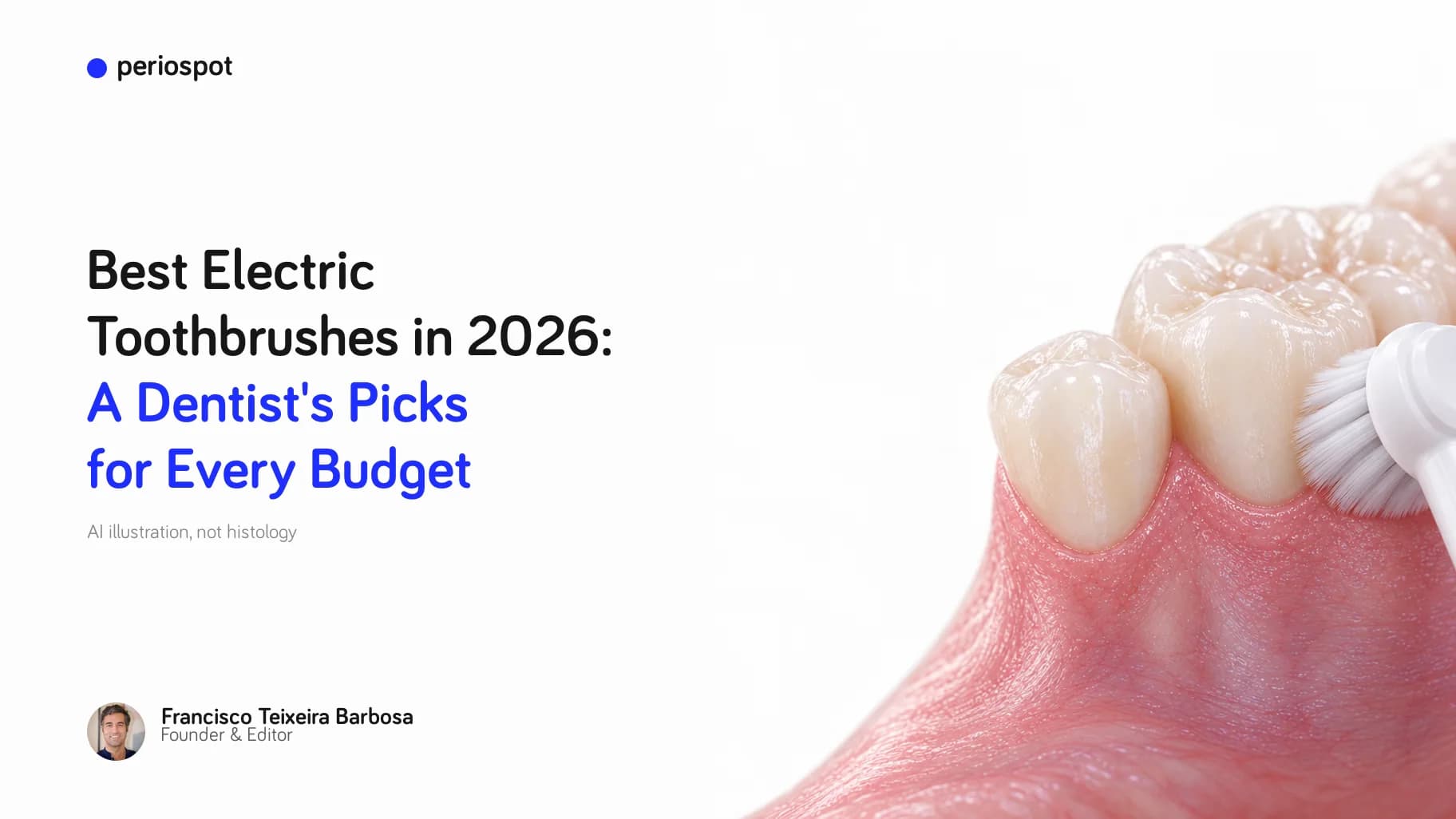
Table of Contents
"Which electric toothbrush should I buy?" It is one of the questions my patients ask me most.
Three years ago I wrote a long guide to electric toothbrushes. Since then, some of those brushes left the market, prices changed, and a few new brands arrived. So here is the 2026 edition: fewer picks, and the research behind each one.
One thing before we start. The best toothbrush is the one you use twice a day, for two full minutes. No motor fixes a rushed brushing. But a good electric brush makes the right technique much easier.
Disclosure: this guide contains affiliate links. If you buy through them, Periospot may earn a small commission at no extra cost to you. It does not change which brushes I recommend.
My picks at a glance
| Toothbrush | Best for | Type | Price |
|---|---|---|---|
| Oral-B iO Series 3 | Best overall | Rotating | $$ |
| Oral-B Pro 1000 | Best on a budget | Rotating | $ |
| Philips Sonicare 4100 | Best sonic for the money | Sonic | $ |
| BURST Pro 2.0 | Best new brand | Sonic | $$ |
| Oral-B iO Series 9 | Best smart brush | Rotating | $$$ |
| Philips Sonicare 9900 Prestige | Most advanced sonic | Sonic | $$$ |
| Philips Sonicare for Kids | Best for children | Sonic | $ |
| SURI 2.0 | Best for travel | Sonic | $$ |
Price: $ under $60, $$ $60 to $150, $$$ over $150 (US prices, October 2026).
Is an electric toothbrush really better than a manual one?
Yes, a little. And the research is fairly consistent.
The largest review comes from Cochrane, a group that pools all the good trials on one question. In 2014 they found 56 trials. In the 51 trials they could combine (4,624 people), electric brushes removed about 11% more plaque than manual brushes in the first three months, and about 21% more after three months. Gum inflammation (gingivitis) went down too: about 6% more in the short term and 11% more in the long term [1].
Those trials last weeks or months. What about years? A German study followed 2,819 adults in Pomerania for 11 years. The people who used an electric brush kept 19.5% more teeth, and their gums lost less support over time [2]. This kind of study shows a link, not proof: people who buy an electric brush may also take better care of their teeth in other ways. Still, it points in the same direction as the trials. (One of the authors had received a grant from Procter & Gamble, the company behind Oral-B.)
To be fair, the NHS says both types are "equally good, as long as you clean all the surfaces" [6]. I agree with the second half of that sentence. My honest summary: an electric toothbrush gives a small but real advantage, and that small advantage, twice a day for years, is worth it for most people.
Rotating or sonic: which type is better?
There are two main families:
- Rotating (oscillating-rotating): a small round head that turns back and forth very fast. This is Oral-B.
- Sonic: a longer head that vibrates from side to side at high speed. This is Philips Sonicare, BURST and SURI.
Studies that compare them find a very small edge for rotating heads. A 2022 network meta-analysis from Amsterdam (28 publications) ranked rotating brushes first for plaque removal after one brushing, then sonic, then manual. The authors called the advantage over sonic "very small" [3]. An older Cochrane review (2010, 15 trials) could not say that any one type is better than another, because too few trials tested the same types [4].
In real life, the gap between the two families is smaller than the gap between brushing well and brushing badly. So pick the one you enjoy using. Some people find a round head easier to guide from tooth to tooth. Others prefer the quieter, softer feel of a sonic brush.
What really matters when you choose
- A pressure sensor. Pressing too hard can hurt your gums and the root surfaces near the gumline. A sensor that lights up, or slows the brush, when you press too hard is the most useful feature of all. Seven of my eight picks have one (the kids' brush does not).
- A two-minute timer. Most good brushes have one, and many also tell you every 30 seconds when to move to the next quarter of your mouth.
- The price of the brush heads. You change the head every three to four months [5]. Over five years, the heads can cost more than the handle. Check the price of a pack of heads before you buy the brush.
- Soft bristles. The American Dental Association recommends a soft-bristled brush [5]. Oral-B, Sonicare and BURST all sell soft or sensitive heads.
- Battery life. Two weeks is plenty at home. If you travel a lot, look for a month or more.
What you can skip: apps, AI tracking and long lists of modes. They are nice, but you do not need them to brush well. "Clean" mode is enough for most mouths, and "Sensitive" is enough for tender gums.
The best electric toothbrushes in 2026
1. Oral-B iO Series 3: best overall

Best for: most adults who want the iO technology without paying for the top model.
What you get: three modes (Daily Clean, Sensitive and Whitening), a smart pressure sensor, a light-ring timer for two minutes, a reminder to change the head, two brush heads and a travel case.
Why I picked it: it has the two features that matter most, a pressure sensor and a timer, with the smoother and quieter iO motor, for much less than the top iO models.
Keep in mind: iO heads only fit iO handles, and they cost more than classic Oral-B heads.
Amazon rating: 4.3 out of 5 (19,000+ ratings, October 2026).
2. Oral-B Pro 1000: best on a budget

Best for: anyone who wants to switch from a manual brush without spending much.
What you get: three cleaning modes, a pressure control that stops the pulsing when you press too hard, a timer that signals every 30 seconds, and a battery light that tells you when to charge.
Why I picked it: it is the cheapest brush I would recommend that has both a pressure sensor and a 30-second pacer. More than 100,000 people have rated it on Amazon.
Keep in mind: the pressure warning has no light, the brush only slows down.
Amazon rating: 4.5 out of 5 (165,000+ ratings, October 2026).
3. Philips Sonicare 4100: best sonic for the money

Best for: people who prefer a quiet, gentle sonic brush on a budget.
What you get: a pressure sensor (the handle pulses when you press too hard), a two-minute timer with a 30-second pacer, a gentle start for the first uses, two intensity settings, a reminder to change the head, and up to 14 days of battery.
Why I picked it: it is the simplest good Sonicare. It has everything that matters and nothing you will stop using after a month.
Keep in mind: there is only one brush head in the box.
Amazon rating: 4.3 out of 5 (23,000+ ratings, October 2026).
4. BURST Pro 2.0: best new brand

Best for: people who like a subscription that sends new heads on time.
What you get: five modes (Whitening, Clean, Massage, Sensitive and Freshen), a real-time pressure sensor, a two-minute timer, a small display that gives you a brushing score, and super-soft tapered bristles. BURST says the battery lasts up to nine months.
Why I picked it: the head subscription ($14 for two heads on the BURST website) solves the most common problem I see in the clinic: heads that stay in the mouth for a year. The brush also has a lifetime warranty while you keep the subscription.
Keep in mind: BURST's own claims, such as "up to 10x more plaque removal", come from the company's data on file, not from published trials. I read them like any advertisement. It also has few Amazon ratings so far.
Amazon rating: 4.6 out of 5 (94 ratings, October 2026).
5. Oral-B iO Series 9: the smart choice

Best for: people who like data and coaching.
What you get: seven modes, a colour display, a pressure sensor that lights up red when you press too hard, a quadrant timer, AI position detection that tracks where you brush (with the app), four brush heads and a charging travel case.
Why I picked it: I have used an Oral-B iO since 2023, and the round head with its gentle micro-vibrations is the reason. If you want the full experience, this is the one.
Keep in mind: most of the extra price pays for the screen, the app and the charging case.
Amazon rating: 4.3 out of 5 (8,000+ ratings, October 2026).
6. Philips Sonicare 9900 Prestige: the most advanced sonic

Best for: sonic fans who want the newest technology.
What you get: a sensor system that checks your pressure, motion and coverage up to 100 times a second and lowers the power if you press too hard, a light ring that warns you, five modes with three intensities, an app, and a charging travel case.
Why I picked it: it is the most complete Sonicare you can buy today.
Keep in mind: the price, and Amazon reviews are mixed (3.8 out of 5 for the single-head pack). If you want a premium Sonicare for less, the older DiamondClean Smart 9300 is still sold and has better ratings (4.5 out of 5, 10,000+ ratings).
7. Philips Sonicare for Kids: best for children

Best for: children from 3 years old, and parents who are tired of the two-minute battle.
What you get: a sonic brush that connects to a free app. The app rewards children for good brushing, and parents can see how long and how often their child brushes.
Why I picked it: with children, the hard part is not the brush. It is the two minutes. The app turns them into a game.
Keep in mind: there is no pressure sensor, and young children still need an adult to help them brush.
Amazon rating: 4.7 out of 5 (15,000+ ratings, October 2026).
8. SURI 2.0: best for travel

Best for: frequent travelers.
What you get: a sonic brush with a pressure sensor, a battery that lasts more than a month, USB-C charging, and a travel case with a UV-C light that cleans the head and charges the brush. SURI says it uses plant-based and recyclable materials.
Why I picked it: one charge covers a long trip, and the case keeps the head clean in your bag.
Keep in mind: it is new on Amazon US, with few ratings so far, and the claims about the UV case are the company's own.
Implants, braces or gum disease? A few extra tips
- Any brush on this list works around implants and crowns. Use a soft head, and the "Sensitive" mode if your gums are tender.
- No toothbrush cleans well between the teeth. Add interdental brushes or floss once a day. A Cochrane review of 35 trials (3,929 adults) found that adding floss or interdental brushes to toothbrushing may reduce gum inflammation, and that interdental brushes may work better than floss [7]. The certainty of that evidence is low to very low, but the advice is cheap and safe.
- Ask your hygienist to choose the size of your interdental brushes. A brush that is too small does not clean. One that is too big hurts.
- With braces, clean each bracket from above, from below and from the front. Ask your orthodontist whether a special head would help you.
- Implants still need professional maintenance visits, even with perfect brushing at home.
Want more? Read my tips and tricks to floss and brush your teeth better, and if fresh breath is your goal, my guide to tongue scrapers.
How to brush with an electric toothbrush, step by step
- Put a small amount of fluoride toothpaste on the head.
- Place the head on your teeth before you switch it on. Less splashing.
- Hold the bristles at the gumline, at about 45 degrees to the gums [5].
- Do not scrub. Let the brush do the work. With a round head, move slowly from tooth to tooth and stay a few seconds on each. With a sonic brush, glide slowly along the teeth.
- Spend 30 seconds on each quarter of your mouth, and clean the outer, inner and chewing surfaces.
- Spit out the toothpaste, but do not rinse with water. Rinsing washes away the fluoride [6].
- Rinse the head under the tap and let it dry standing up.
How often should you change the brush head?
Every three to four months, or sooner if the bristles are frayed. That is the advice of the American Dental Association [5]. Several brushes on this list remind you when it is time.
Frequently asked questions
Is an electric toothbrush worth the money?
For most people, yes. Electric brushes remove a little more plaque and reduce gum inflammation a little more than manual brushes [1]. You do not need an expensive model to get that benefit.
Which is better, Oral-B or Sonicare?
Studies give a very small edge to rotating brushes like Oral-B [3]. The difference is so small that comfort should decide. Choose the one you will use every day.
Can I use an electric toothbrush on dental implants?
Yes. Use a soft head and gentle pressure, clean between your implants with interdental brushes, and keep your maintenance visits.
Can children use an electric toothbrush?
Yes, with a model made for children and with an adult's help. The Philips Sonicare for Kids is designed for children from 3 years old.
Is a cheap electric toothbrush good enough?
Yes, if it has a two-minute timer and a pressure sensor. The Oral-B Pro 1000 and the Philips Sonicare 4100 both cost under $60.
My final recommendation
If you only read one line, read this one: buy the Oral-B iO Series 3, or on a budget the Oral-B Pro 1000 or the Philips Sonicare 4100. Then spend the money you saved on interdental brushes and a professional cleaning.
And you? Which brush do you use, and would you change it? Tell me in the comments.
References
- Yaacob M, Worthington HV, Deacon SA, et al. Powered versus manual toothbrushing for oral health. Cochrane Database Syst Rev. 2014;(6):CD002281. doi:10.1002/14651858.CD002281.pub3
- Pitchika V, Pink C, Völzke H, Welk A, Kocher T, Holtfreter B. Long-term impact of powered toothbrush on oral health: 11-year cohort study. J Clin Periodontol. 2019;46(7):713-722. doi:10.1111/jcpe.13126
- Thomassen TMJA, Van der Weijden FGA, Slot DE. The efficacy of powered toothbrushes: a systematic review and network meta-analysis. Int J Dent Hyg. 2022;20(1):3-17. doi:10.1111/idh.12563
- Deacon SA, Glenny AM, Deery C, et al. Different powered toothbrushes for plaque control and gingival health. Cochrane Database Syst Rev. 2010;(12):CD004971. doi:10.1002/14651858.CD004971.pub2
- American Dental Association. Brushing your teeth. MouthHealthy. mouthhealthy.org
- NHS. How to keep your teeth clean. nhs.uk
- Worthington HV, MacDonald L, Poklepovic Pericic T, et al. Home use of interdental cleaning devices, in addition to toothbrushing, for preventing and controlling periodontal diseases and dental caries. Cochrane Database Syst Rev. 2019;4(4):CD012018. doi:10.1002/14651858.CD012018.pub2
Comments
0 totalLoading comments...
Previous
How to Use Social Media to Grow Your Dental Clinic: 11 Simple Recommendations (2026 Edition)
Related Articles
How to Use Social Media to Grow Your Dental Clinic: 11 Simple Recommendations (2026 Edition)
8 min read
6 Online Marketing Tools a Real Dental Clinic Can Use in 2026
9 min read