Dental KOL Marketing: How Implant and Periodontal Brands Build Their Key Opinion Leader Bench

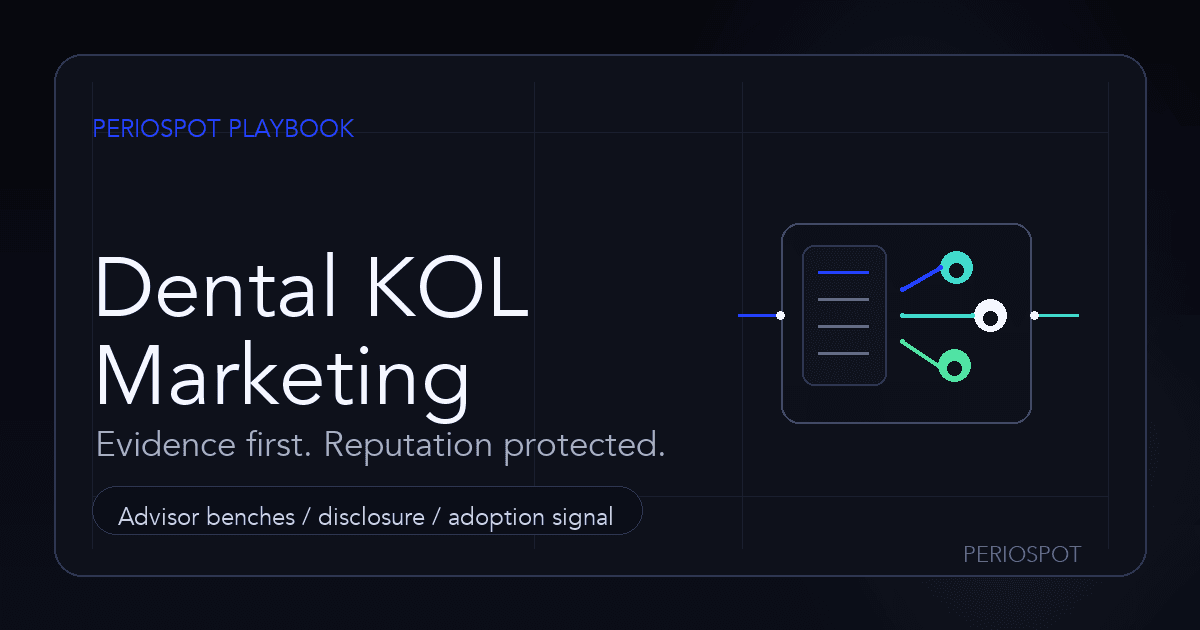
Table of Contents
Related clinical guides
A few years ago, I would hear dental companies talk about KOLs and the conversation almost always started with the wrong question: who is famous enough to get attention?
I understand why that happens. Visibility is easy to measure. But in implant and periodontal education, the better question is different: who can explain the product without breaking the evidence?
A serious dental KOL collaboration is not a shortcut for borrowing someone's reputation. It is a structured way to test whether the science, the claim, and the message survive peer scrutiny.
That distinction matters. In dentistry, a KOL can influence how clinicians understand an implant system, regenerative material, chairside diagnostic workflow, digital workflow, or periodontal product. But if the program is only a list of famous names, it becomes fragile very quickly.
The better approach is to build a bench.
Short answer: a dental KOL program should define the evidence, assign clear expert roles, disclose commercial relationships, create clinically useful assets, and measure whether the program improves adoption conversations.
Why dental KOL marketing is different
A normal influencer campaign usually starts with reach: audience size, engagement rate, content style, posting frequency, and platform fit. Those things matter, but they are not enough for dental and implant brands.
A dental KOL is operating inside a clinical trust system. The audience is not only asking, "Do I like this person?" The audience is asking:
- Does this clinician understand the indication?
- Would I trust this person with a complex case?
- Is the claim proportionate to the evidence?
- Is the commercial relationship visible?
- Would this explanation help me make a better clinical decision?
That is why dental KOL marketing should sit inside a broader clinical communication strategy. The KOL is not the strategy. The KOL helps stress-test and distribute the strategy.
A KOL bench is not a list of famous dentists
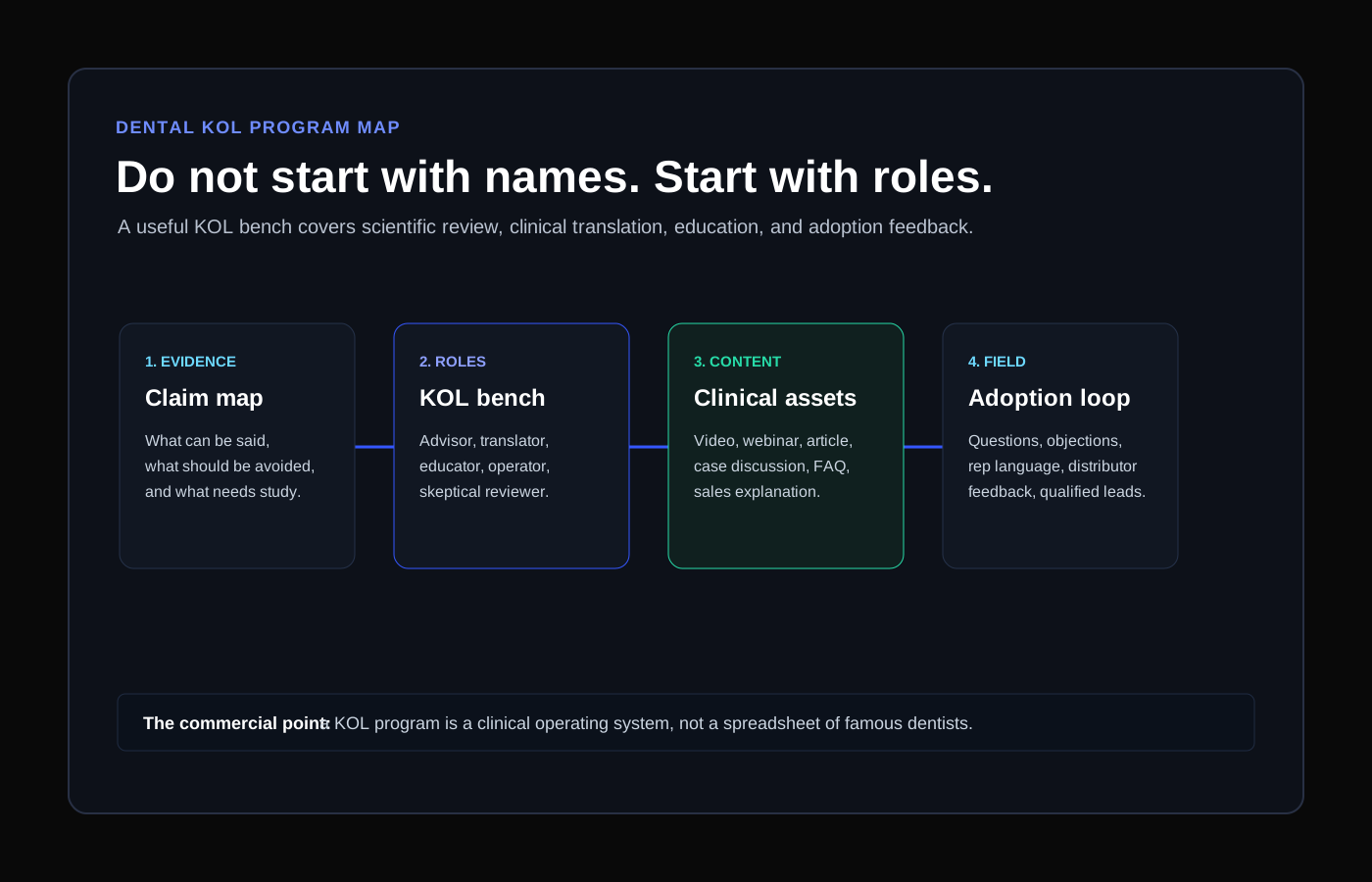
The weakest KOL programs begin with a spreadsheet of names. The strongest ones begin with roles.
For an implant or periodontal brand, I would usually separate the bench into five functions:
- Scientific advisor: reviews the literature, product data, claim boundaries, and gaps.
- Clinical translator: explains where the product fits in real treatment planning.
- Educator: teaches through video, webinars, lectures, and articles.
- Field listener: brings back objections, misunderstandings, and practical questions from clinicians.
- Skeptical reviewer: protects the brand from overclaiming before the market does it publicly.
Sometimes one clinician can hold more than one role. But if every KOL is selected only because they are visible online, the bench will be unbalanced.
Start with claim boundaries before choosing the expert
Before approaching any KOL, the brand should write the claim-boundary map.
That map should answer:
- What is the strongest claim the evidence supports?
- Which claim is tempting but too strong?
- Which indication, case type, or clinician audience is the best fit?
- What limitation should be stated openly?
- Which words should be avoided in videos, webinars, posts, and lectures?
This is where many dental KOL collaborations become commercially risky. The KOL is asked to be enthusiastic before the claim is disciplined. The clinician then has to carry language that the evidence may not support.
That is not fair to the expert, and it is not useful for the brand.
This article is not legal advice. Every company needs its own regulatory and legal review. But for device and sponsored-content work, the direction is clear: medical device labeling and advertising can be sensitive, misleading claims are a problem, and material commercial relationships should be disclosed clearly. Useful official references include the FDA device labeling overview, Regulation (EU) 2017/745, and the FTC's Disclosures 101 for Social Media Influencers.
How to select dental KOLs
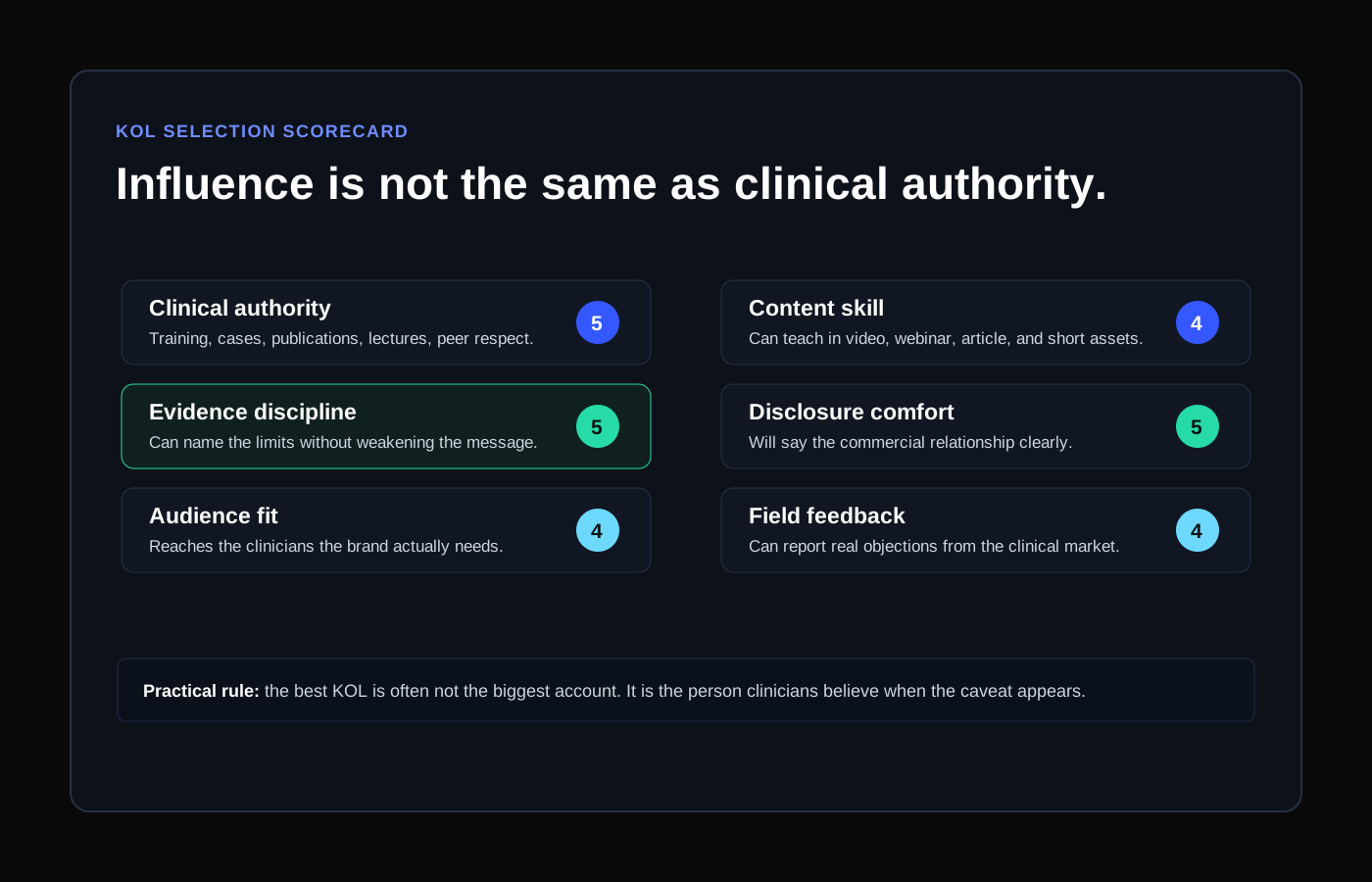
The best KOL is not always the person with the biggest account. In a technical dental category, the most valuable person may be the clinician who can explain the caveat without losing the room.
I would score candidates across six dimensions:
- Clinical authority: training, case experience, teaching, peer respect, publications, or society involvement.
- Evidence discipline: ability to separate strong evidence from plausible but weaker claims.
- Audience fit: whether their audience matches the brand's target clinicians.
- Content skill: ability to teach clearly in video, webinar, short clips, articles, or lectures.
- Disclosure comfort: willingness to make the commercial relationship visible.
- Field feedback: ability to bring back real objections from the clinical market.
Do not hide the commercial relationship
A disclosed KOL collaboration can still be trusted. A hidden one usually cannot.
In practical terms, the disclosure should be visible in the asset itself and in the supporting distribution layer. That can mean an in-video line, a webinar intro, a post label, a newsletter note, or a landing-page banner. The exact wording depends on the market and should be reviewed by the brand's legal team.
But the clinical principle is simple: the audience should not have to investigate whether the relationship exists.
Periospot's default language is intentionally plain:
- In partnership with...
- Supported by...
- This educational content was produced with support from...
- Francisco retains editorial control over the clinical framing.
The last sentence matters. If the KOL or publisher has no editorial independence, the asset will feel like an advertisement with a clinical face.
What content should a KOL program produce?
A serious KOL program should not produce isolated posts. It should create a content ladder.
For a dental or implant brand, that ladder might include:
- Evidence review: one article or internal document that defines claim boundaries.
- Flagship video: a long-form clinical explanation or expert interview.
- Webinar: a 45-60 minute session with disclosure, case selection, and Q&A.
- Short clips: focused answers to the main clinician objections.
- Newsletter feature: a qualified audience entry point for the deeper asset.
- Sales enablement: a KOL-approved FAQ that keeps reps from overclaiming.
This connects directly to dental video marketing. The video is stronger when it is part of a system, and the KOL is stronger when the script protects the evidence.
A 90-day dental KOL program plan
If a brand wanted to test this without committing to a full annual program, I would start with a 90-day pilot.
Days 1-15: evidence and role mapping
- Collect approved claims, product data, studies, case material, objections, and competitor messaging.
- Separate strong claims from claims that need softer language.
- Define which KOL roles are needed first.
- Create the first version of the disclosure and editorial-control language.
Days 16-35: bench selection
- Score potential KOLs by role, not only reach.
- Identify one scientific advisor, one clinical translator, and one education/distribution partner.
- Run a discovery call around evidence, limits, and audience fit.
- Decide whether the first public asset should be an article, video, webinar, or case discussion.
Days 36-65: first asset system
- Create the flagship clinical asset.
- Extract short clips, newsletter copy, and sales FAQ language.
- Check disclosure and claim boundaries before publication.
- Publish through the most qualified channel, not simply the loudest channel.
Days 66-90: feedback and next decision
- Collect clinician questions, saves, shares, objections, and qualified replies.
- Ask the sales and distributor teams whether the content improved the conversation.
- Update the claim map based on real market feedback.
- Decide whether to expand into a webinar series, multi-KOL bench, or full Clinical Communication Playbook.
What to measure in KOL marketing
The easiest metric is reach. The most useful metric is movement in the quality of the clinical conversation.
| Signal | What it tells you | Why it matters |
|---|---|---|
| Clinician questions | The audience understood enough to ask better questions | Shows real professional engagement |
| Saves and shares | The asset has practical value | More useful than passive impressions |
| Sales language consistency | The team can repeat the claim without exaggerating it | Reduces drift in the field |
| Distributor feedback | The channel can explain the product more clearly | Connects education to commercial adoption |
| Qualified leads | The right people want the next conversation | Converts trust into opportunity |
Where Periospot fits
Periospot can help dental and medical device brands build KOL programs that are clinically credible from the start.
The work can include evidence mapping, claim boundaries, KOL role design, expert briefing, sponsored educational articles, KOL program strategy, clinical video, webinars, newsletter placement, and feedback reporting.
The larger version is the Clinical Communication Playbook: a custom operating manual for the brand's evidence base, voice, content pillars, KOL assets, citation standards, and 12-month communication system.
Periospot KOL programs
Need a KOL program that protects the evidence and the expert?
Explore Periospot KOL programs for dental and medical device brands: advisor benches, clinical video, sponsored webinars, newsletter features, and claim-boundary systems.
Explore KOL programsWhat this framework misses
The honest truth: a good KOL bench does not rescue a weak product, weak evidence, or a sales team that wants the expert to say more than the data allows.
There is also a human problem. KOLs are clinicians with reputations, preferences, blind spots, and limited time. A spreadsheet scorecard helps, but it cannot replace judgment. The brand still has to listen when a serious expert says, "This claim is too much."
That is why I prefer smaller, disciplined pilots before a big annual KOL program. If the first asset cannot survive the caveats, the larger program will not become more credible just because more people repeat it.
FAQ
What is dental KOL marketing?
Dental KOL marketing is the structured use of respected clinicians to help a dental or medical device brand translate evidence into education, feedback, and adoption conversations.
How is dental KOL marketing different from influencer marketing?
Dental influencer marketing often focuses on reach and attention. Dental KOL marketing should focus on clinical authority, evidence discipline, disclosed collaboration, peer education, and field feedback.
What should a dental KOL program include?
A dental KOL program should include evidence mapping, role definition, advisor selection, visible disclosure rules, content architecture, review workflows, and adoption metrics.
Should implant brands work with one famous KOL or a bench of advisors?
Most implant and periodontal brands need a bench, not a single famous clinician. Different KOLs can support scientific review, clinical translation, education, objection handling, and regional adoption.
What metrics matter in dental KOL marketing?
Useful metrics include quality of clinician questions, webinar attendance, saves, shares, sales-team language consistency, distributor feedback, qualified leads, and whether KOL content improves adoption conversations.
Related Periospot reading
For the wider strategy, read Medical Device Marketing Strategy for Dental and Implant Brands. For video execution, read Dental Video Marketing. For the content system behind this approach, read Healthcare Content Marketing for Dental Brands and see the anonymized clinical communication case study.
Comments
0 totalLoading comments...
Previous
Dental Video Marketing: How Brands Use Clinical Video to Drive KOL Adoption
Next
Connective Tissue Graft: The Biology Behind the Procedure