Healthcare Content Marketing for Dental Brands: A 2026 Playbook

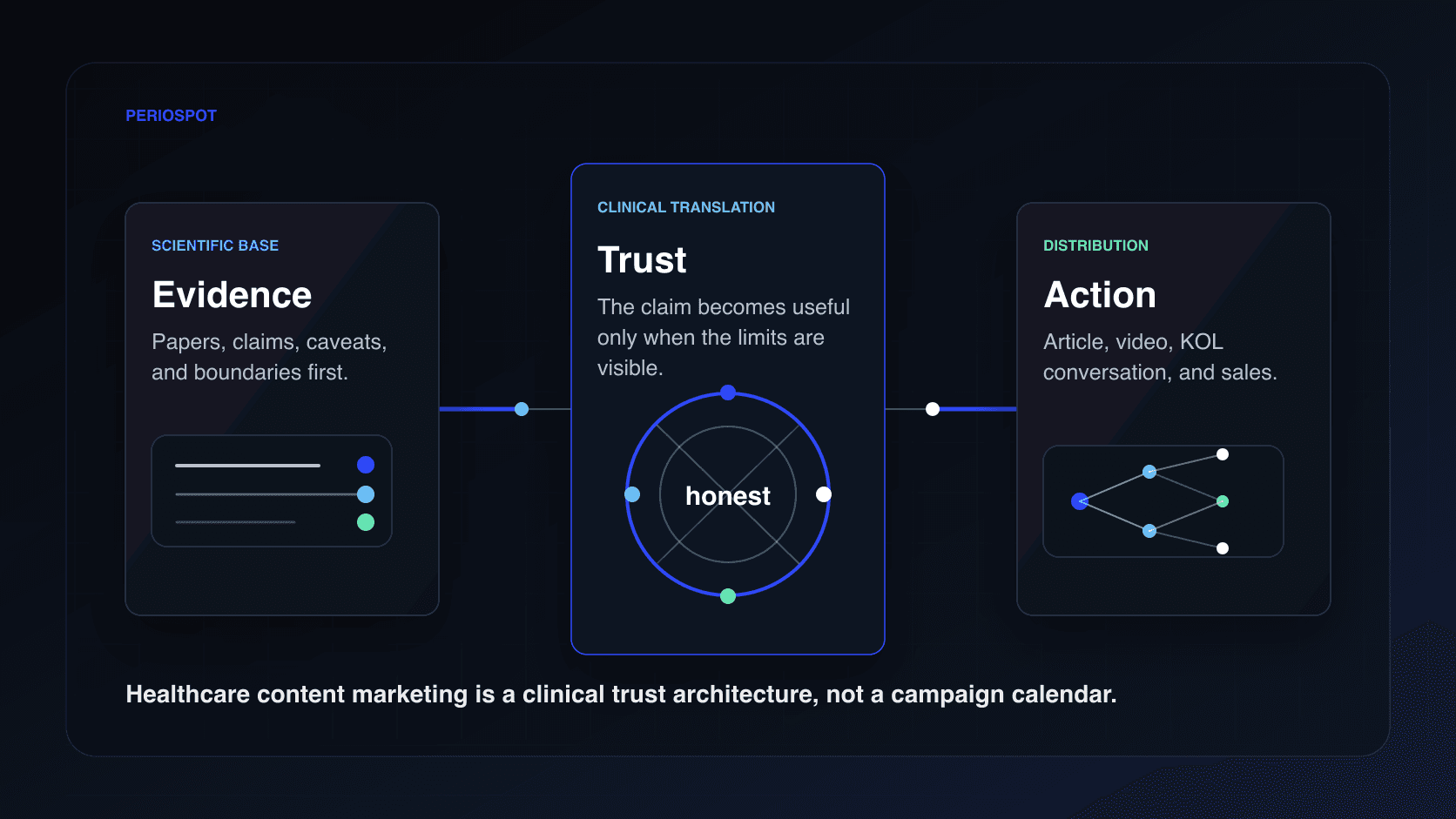
Table of Contents
Related clinical guides
A few years ago, if a dental company asked me about marketing, I would probably think about a nice video, a beautiful carousel, or maybe a sponsored lecture.
Now I think about something different.
I think about whether the dentist on the other side will trust the argument. I think about whether the claim is proportional to the evidence. I think about whether the content explains the limitations with the same energy that it explains the benefits.
That is the difference between generic marketing and healthcare content marketing for dental brands.
And yes, I know. This is not the typical Periospot article about immediate implants, soft tissue grafts, or the bundle bone. But it matters because dental brands, labs, manufacturers, and study clubs are now competing in a market where attention is cheap and trust is expensive.
Short answer: healthcare content marketing for dental brands is not about publishing more posts. It is about building clinically useful communication that helps dentists understand what a product does, what the evidence supports, and where the caveats still are.
Why healthcare content marketing is different from generic B2B content
Generic B2B content can survive with a clever hook, a tidy framework, and a strong call to action. Healthcare content has a different problem. The reader is not only asking, "Is this interesting?" The reader is asking, "Can I trust this enough to bring it into a clinical conversation?"
That changes the work.
- The claims have consequences. If a product claim is inflated, the damage is not only reputational. It can change clinical expectations.
- The audience is trained to be skeptical. Periodontists, implant dentists, oral surgeons, hygienists, and educators are used to looking for the weak point in an argument.
- The buyer is often not one person. A brand may need to convince a clinician, a distributor, a purchasing team, a KOL, and an internal sales team at the same time.
- The content has to travel. A good clinical argument becomes a webinar, a sales explanation, a newsletter feature, a short video, a lecture slide, and a reference page.
This is why a dental brand cannot simply copy the SaaS playbook. The dental market needs content that is clear, visual, restrained, and clinically literate.
What is healthcare content marketing?
Healthcare content marketing is the creation and distribution of educational content that helps a professional audience understand a clinical, scientific, or health-related decision.
For dental and implant brands, that usually means content around questions like these:
- Where does this product fit in the clinical workflow?
- Which cases are appropriate, and which cases are not?
- What does the literature actually support?
- What are the risks, limitations, and unanswered questions?
- How should clinicians explain this to patients or colleagues?
That last point is important. The best content does not only create demand. It improves the quality of the conversation around the product.
The 2026 dental-brand content stack
A dental brand does not need to be everywhere. It needs a stack that explains the idea at different levels of depth.
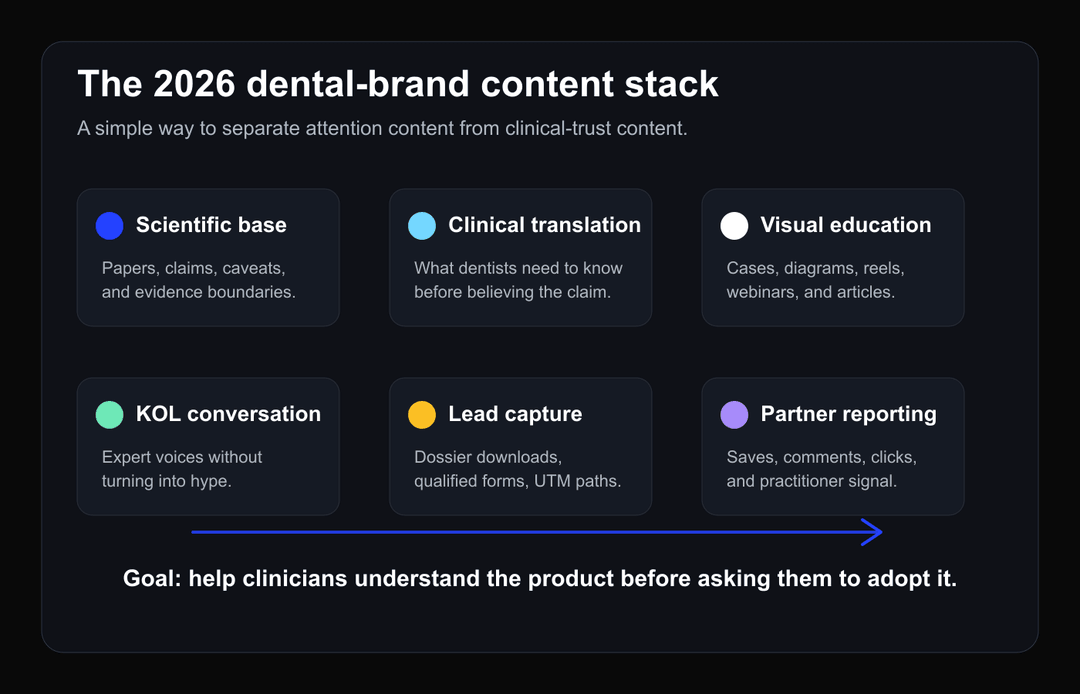
For most brands, the stack should include five layers.
1. The evidence base
This is the raw material: clinical studies, product data, case documentation, adverse-event considerations, regulatory boundaries, and the language the company is allowed to use.
If this layer is weak, the rest of the content becomes expensive decoration.
2. A flagship article or guide
This is the central explanation. It can rank in search, support sales conversations, and become the reference page that other assets point back to. For example, a chairside diagnostics company may need a guide on how a diagnostic workflow should and should not influence clinical decisions.
The goal is not to make every dentist agree. The goal is to make the serious reader say, "This is a fair explanation."
3. Dental video marketing
Video is where complex clinical ideas become human. A 10-minute deep-dive, expert interview, or case-based explanation can do what a static ad cannot: show how a clinician thinks through the problem.
The best dental video marketing is not a product monologue. It is a structured argument with clinical context, evidence, and honest limits.
4. Short-form distribution
Reels, YouTube Shorts, carousels, and LinkedIn clips are the entry points. They should not carry the whole scientific burden. Their job is to open a clinically relevant question and point the right person toward the deeper asset.
5. Sales and KOL enablement
Good content should help the internal team. If the sales team cannot use the article, if the KOL cannot adapt the diagrams, or if the product team cannot point to the evidence boundaries, the content system is incomplete.
Dental video marketing and KOL collaboration
Dental video marketing works because dentistry is visual. We learn through anatomy, workflow, surgery, images, movement, and judgment. But that also means the standard is higher.
A polished video with a weak claim is still a weak claim.
For KOL collaboration, I would separate three formats:
| Format | Best use | Main risk |
|---|---|---|
| Expert interview | Explaining a field, controversy, or emerging diagnostic category | Becoming too general and not giving the viewer a practical conclusion |
| Technique deep-dive | Showing how a product or concept fits into a clinical sequence | Overstating transferability from one case to all cases |
| Evidence review | Building credibility around a claim, category, or indication | Ignoring the negative or uncertain parts of the literature |
This is also where disclosure matters. A clinician can accept sponsored education when the relationship is visible. What clinicians dislike is the feeling that the commercial relationship is hidden inside the content.
Dental marketing agency or clinical communication partner?
A dental marketing agency can be very useful. Many clinics and brands need websites, paid ads, funnels, social scheduling, design systems, and campaign execution. There is nothing wrong with that.
But if the central challenge is clinical trust, the question changes.
You probably need a clinical communication partner when:
- The product is scientifically complex.
- The claim needs careful wording.
- The audience is mostly clinicians, KOLs, labs, manufacturers, or distributors.
- The sales team struggles to explain where the product fits.
- The brand needs educational content that can survive clinical scrutiny.
You probably need a traditional agency when:
- The main problem is lead generation for a dental clinic.
- The offer is simple and already well understood.
- The content does not require literature review or clinical positioning.
- The brand mainly needs media buying, web design, or local SEO execution.
The strongest setup may be both: a clinical communication system that defines the evidence, messaging, and content architecture, plus an agency or internal team that executes distribution.
Measurement: what to track when the buyer is a clinician
Dental brands often measure the wrong thing. Views matter, but views alone do not tell you whether the right person understood the idea.
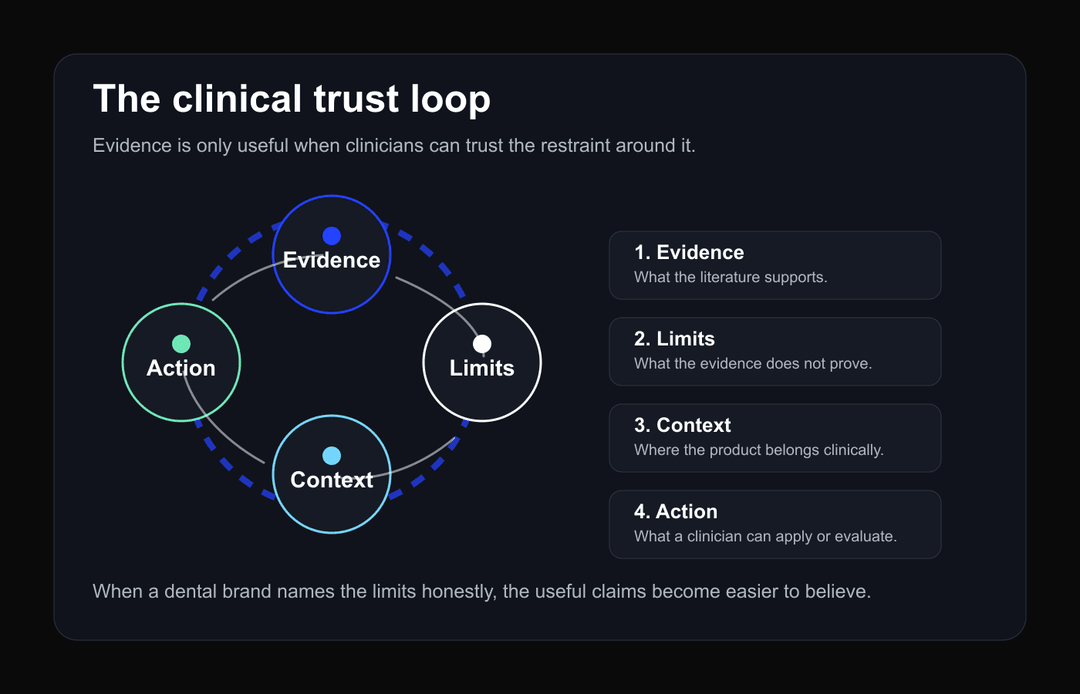
For healthcare content marketing, I would track four groups of signals.
- Qualified attention: saves, shares, watch time, webinar attendance, and repeat visits from professional audiences.
- Clinical engagement: comments and questions from dentists, periodontists, oral surgeons, hygienists, educators, and product specialists.
- Commercial movement: link-throughs, demo requests, distributor conversations, qualified email leads, and sales-team usage.
- Message quality: fewer misunderstandings, better sales explanations, clearer KOL language, and more precise claim boundaries.
That last one is difficult to measure, but it is often the most important. If content reduces confusion around a product, it is doing real work.
A 90-day starter plan for a dental brand
If I were helping a dental brand start from zero, I would not begin with 30 posts. I would begin with one strong clinical argument and build around it.
Days 1-15: define the claim boundaries
- List the main product claims.
- Separate what is strongly supported from what is promising but uncertain.
- Identify words that are too strong and need replacing.
- Build a small reference library.
Days 16-35: create the flagship asset
- Write the main article or clinical guide.
- Build diagrams that explain the workflow.
- Add a clear limitations section.
- Prepare one call to action for qualified readers.
Days 36-60: turn the argument into video
- Record a deep-dive or expert conversation.
- Extract short clips for social distribution.
- Create a carousel that explains the key clinical decision.
- Connect each asset back to the flagship guide.
Days 61-90: distribute and learn
- Publish through newsletter, LinkedIn, YouTube, Instagram, and partner channels.
- Track clinician questions, objections, and misunderstandings.
- Update the article and sales language based on feedback.
- Decide whether the topic deserves a webinar, KOL roundtable, or full playbook.
When to bring in a clinical communication services partner
The right time is usually when the brand has real science but the message is not landing.
Maybe the product is strong, but the content sounds like every other dental product campaign. Maybe the sales team has good conversations one-to-one, but the public content feels generic. Maybe the company has a KOL, but the content system around that KOL is not structured enough.
That is the gap Periospot is building for.
Our Clinical Communication Services for Dental Brands are designed for companies that need more than exposure. The offer includes Periospot channel placement, dental video production, sponsored educational assets, and a premium Clinical Communication Playbook built around the brand's evidence base.
It also includes something that is commercially uncomfortable but clinically necessary: the limitations.
Every serious partner has to survive the caveats. That is the point.
Periospot for dental brands
Need clinicians to understand the science behind your product?
Explore Periospot clinical communication partnerships: sponsored educational content, dental video, newsletter features, webinars, and custom communication playbooks.
Explore clinical communication servicesFAQ
What is healthcare content marketing for dental brands?
Healthcare content marketing for dental brands is the use of educational, evidence-based content to help clinicians understand a product, technology, or clinical idea before they are asked to buy, recommend, or adopt it.
Is this the same as dental practice marketing?
No. Dental practice marketing usually targets patients and local clinic growth. Dental brand content marketing targets professional audiences: clinicians, KOLs, distributors, labs, manufacturers, educators, and internal sales teams.
Does sponsored dental content damage trust?
It can, if it is hidden or exaggerated. It can also build trust when the sponsorship is disclosed, the evidence is cited, and the limitations are explained clearly.
What should a dental brand create first?
Create one flagship clinical guide or article that explains the product category honestly. Then turn that argument into video, short clips, carousels, newsletter content, and sales enablement materials.
Related Periospot reading
If you want to see how clinical education has worked on Periospot before, start with 12 facts about the bundle bone, the gap, and immediate implants, the alveolar ridge preservation guide, and the dental photography guide. Different topics, same principle: make the clinical idea easier to understand without pretending it is simpler than it is.
Comments
0 totalLoading comments...
Previous
How I Grew 13,000 New Instagram Followers in Under 2 Weeks Using AI Videos (And the Exact Prompts I Used)
Next
Medical Device Marketing Strategy for Dental and Implant Brands: What Works in 2026
Related Articles
Dental KOL Marketing: How Implant and Periodontal Brands Build Their Key Opinion Leader Bench
11 min read
12 facts about the Bundle Bone, the Gap and Immediate Implants.
2 min read