

Szeged, early 1930s
I love books about Hungarian history. Let me start with a story from it.
One evening in Szeged, in the early 1930s, a Hungarian scientist did not want to eat his dinner. His wife had served him fresh red paprika. Albert Szent-Györgyi had a better idea: he took the paprika to his laboratory. By midnight, as he later wrote, he knew it was "a treasure chest full of vitamin C". Within a few weeks he had made enough pure vitamin C to prove what it was.
In 1937 he received the Nobel Prize, for his discoveries on how living cells burn their fuel, the biological combustion that runs on oxygen, and on vitamin C. Today the medical faculty in Szeged carries his name.
His two discoveries meet in every healing wound. The enzyme that makes new collagen strong needs oxygen and vitamin C at the same time. Take away vitamin C and you get scurvy: bleeding gums, and old wounds that open again. Take away oxygen and the same enzyme slows down.
So this article asks an old Hungarian question in a new tube: can we help a wound by bringing it oxygen?
Győr
Szent-Györgyi worked at one end of Hungary. I grew up at the other end. When I was a boy in Győr, my mother was the family doctor of a well-kept industrial village just outside the city. In those years, family doctors covered 24-hour shifts, and when a patient called in the middle of the night, she went. Some nights the family went along to keep her company.
What I remember is the waiting. A light on in a house in the village, my mother's bag on the table, and the patients she had to visit again and again because a wound would not close.
Those were crazy times. It is different now, thankfully. My mother is a general practitioner, an internal medicine specialist and a diabetologist, and she is still my role model.
I wanted to be a doctor like her, so I started medicine at the University of Pécs. Then, in 2009, I was diagnosed with type 1 diabetes. After a lot of thinking, I changed course: I moved to Semmelweis University in Budapest, and to dentistry. My PhD became a study of what diabetes does to the mouth. Today, people with diabetes in Hungary can have their mouth screened for free, through Semmelweis University and at every dentist covered by the national health insurance.
So healing is a personal subject for me. In diabetes, a small wound can become a long story. Blood flow, blood sugar and oxygen all decide how fast tissue closes.
Semmelweis University, 2026
That is why, when our team at Semmelweis decided to read every human study on an oxygen-releasing gel, I had one quiet hope: maybe this is a simple tool for the patients who heal slowly.
I wrote this article together with Dr Gábor Kammerhofer, my former PhD student, now a PhD himself and a co-author of the review.
We found 35 clinical studies. The one I cared about most, the only trial we judged at low risk of bias, was done in patients with diabetes. I will tell you what it found. First, let me explain why anyone would put oxygen in a tube.
The short version
- 35
- human studies: 24 on the gel, 8 on the mouthwash, 3 on the toothpaste
- 1 of 32
- randomized trials at low risk of bias. It found no extra benefit after 180 days.
- 5 of 6
- depigmentation studies at high risk of bias, although all six favoured the gel early
- 0
- studies designed to prove the mouthwash is "as good as" chlorhexidine
Source: Nagy et al., Gels 2026, Figure 2 and section 2.2 (risk of bias).
Why a wound needs oxygen
Every step of healing burns oxygen. Cells need it to make energy. Fibroblasts need it to build collagen: the enzyme that stabilizes new collagen fibres cannot work without it. New blood vessels, migrating epithelial cells and the neutrophils that kill bacteria all depend on it.
The problem is that a fresh wound is often short of oxygen. The vessels that should bring it are cut or crushed. Low oxygen means slow collagen, slow closure and an easier life for bacteria.
There is a second side to the story. Oxygen also forms reactive oxygen species. At low levels they are signals: they tell cells to divide, to build vessels and to remodel tissue. At high levels they damage the same tissue they should help. Healing needs the right amount, not the most.
Now think about a periodontal pocket. As it deepens, the oxygen at the bottom falls. That low-oxygen space is a comfortable home for the anaerobes we know too well: Porphyromonas gingivalis, Treponema denticola, Tannerella forsythia. The same thing happens around implants with mucositis and peri-implantitis.
Medicine already uses oxygen for difficult wounds, for example in hyperbaric chambers, where the whole patient breathes oxygen under pressure. Topical oxygen therapy has a simpler idea. Put a material on the wound that releases oxygen right there, and nowhere else.
Established
What oxygen does in healing
- Energy for every healing cell
- Strong new collagen
- New blood vessels
- Epithelium moving across the wound
- Neutrophils killing bacteria
Established
The balance
Reactive oxygen species:
At low levels they tell cells to divide, build vessels and remodel tissue. At high levels they harm the tissue they should help.
Proposed, not measured
Where topical oxygen sits
A material on the wound releases oxygen right there. Whether a specific product delivers the right amount, to the right depth, has not been measured in the human mouth.
One honest caveat before we go further. Everything in the last four paragraphs comes from general wound biology. Whether a specific product delivers that oxygen, in the right amount, to the right depth, is a separate question. And that is the question our review asked.
What is inside the tube
The product we studied is Blue®M, developed in the Netherlands by a team of dental surgeons led by Dr Peter Blijdorp. It comes as a gel, mouthwash, toothpaste, foam and spray. The gel gets most of the research, because it stays in contact with tissue: in pockets, around implants, in extraction sockets and on surgical wounds.
Three ingredients carry the idea:
- Sodium perborate, an inorganic salt.
- Glucose oxidase, an enzyme that comes from honey.
- Lactoferrin, a protein found in milk, richest in the first milk after birth. It binds iron, which many bacteria need to grow. In laboratory research it has antimicrobial and immune effects.
When the first two meet saliva, blood or a moist mucosa, they react. The company's own website says the reaction releases oxygen "in the form of peroxide of hydrogen", slowly and gradually. Our review describes the same thing: oxygen species and low levels of hydrogen peroxide.
What is inside the tube
Lactoferrin binds iron, which many bacteria need to grow.
Not measured in the human mouth
Here is the part I want every reader to remember: this release has not been measured directly in the human mouth. We do not know how much oxygen reaches the bottom of a pocket, how deep it goes, or for how long. The mechanism is plausible. It is not proven.
Lesson 1: Open, shallow wounds are where the signal lives
The clearest results come from wounds you can see.
Gingival depigmentation is a good model. You remove the pigmented epithelium with a scalpel, and the wound heals from its edges over two to four weeks. Six studies compared the gel with Coe-Pak, the classic periodontal dressing. All six pointed in the same direction:
- Less pain in the first days. In one trial, pain was lower from day 1 to day 5 and the same after that.
- Faster closure. In the same trial, 90 of every 100 gel sites were fully covered by new epithelium at two weeks, against 30 of every 100 dressing sites. By one month, both sides were healed.
- Patients preferred it. In a trial of 28 patients, 75 of every 100 chose the gel side, and 11 of every 100 the dressing.
The healing race
Sites fully covered by new epithelium, out of 100
The same pattern appeared on the palate after harvesting a free gingival graft (60 patients) and in extraction sockets (30 patients: less pain on day 3 but not on day 7, and better healing scores on both days).
Now the warning. Five of the six depigmentation studies were at high risk of bias. The main reason is simple: the people who scored pain and healing knew which side got the gel. Pain is subjective. When the patient and the clinician both know, the score moves.
And when the gel met a real competitor, the advantage disappeared. After crown lengthening, a double-blind trial of 40 patients compared it with hyaluronic acid gel: no difference in healing or pain.
My reading: on an open, shallow wound, the gel may mean less pain in the first days and faster closure over the first two to three weeks, compared with a dressing. It does not change where the wound ends up, and it has not beaten hyaluronic acid.
Lesson 2: In a pocket, the instrument does the work
Eleven studies added the gel to scaling and root planing. Several small split-mouth trials reported extra pocket reduction, often under 1 mm, after six weeks to three months. None of them was at low risk of bias.
Then there is the trial that matters most to me.
Cláudio and colleagues treated 51 patients with poorly controlled type 2 diabetes and stage III or IV, grade C periodontitis, the residual pockets nobody wants. It was double-blind and registered. Patients received instrumentation alone, instrumentation plus 0.4 mL of gel left in the pocket for 3 minutes, or the gel plus photodynamic therapy. They were followed for 180 days.
All three groups improved. There was no difference between the groups at any time point: not in pockets, not in attachment, not in inflammatory markers, not in HbA1c.
The only trial at low risk of bias
Instrumentation alone
17 patients
Plus 0.4 mL gel for 3 minutes
17 patients
Plus gel and photodynamic therapy
17 patients
Good instrumentation helped them. The gel added nothing we could measure.
One more detail, because it matters for trust. This was the only study in the whole review that disclosed partial sponsorship from the manufacturer. The company-supported trial was the most careful one, and it was the one that found no benefit.
Against chlorhexidine gel, three studies exist. Two were at high risk of bias. We cannot draw a conclusion either way.
Can a Gel Bring Oxygen to a Wound?
Companion video for this article, narrated from its text. Vertical 9:16, 1:39.
Lesson 3: "No difference" is not "just as good"
Several trials compared the oxygen mouthwash with chlorhexidine and found no significant difference, including one in intensive care (62 intubated patients randomized, 50 analyzed).
It is tempting to write "as good as chlorhexidine". Please don't.
A small trial that finds no difference has two possible meanings. Either the two treatments are similar, or the study was too small to see the difference. To claim "as good as", a trial must be designed for it from the start: a pre-specified margin, enough patients, and an analysis built on confidence intervals. None of these trials was. One toothpaste study called the two products "equivalent", and the design does not support that word either.
Why small trials cannot say "as good as"
With 20 patients per group: we cannot tell.
The correct sentence is shorter: we could not tell them apart.
Lesson 4: Comfort counts, and chlorhexidine has a price
Chlorhexidine works. Every clinician also knows what patients say after two weeks of it.
In a pilot trial of 50 patients rinsing twice a day for two weeks: altered taste in 12 of every 100 patients with the oxygen mouthwash against 40 of every 100 with chlorhexidine 0.2%, burning in 0 of every 100 against 48 of every 100, and staining in 0 of every 100 against 32 of every 100.
Side effects, out of every 100 patients
Altered taste
Oxygen rinse: 12 of 100
Chlorhexidine 0.2%: 40 of 100
Burning
Oxygen rinse: 0 of 100
Chlorhexidine 0.2%: 48 of 100
Staining
Oxygen rinse: 0 of 100
Chlorhexidine 0.2%: 32 of 100
A second trial saw the same thing: with chlorhexidine, 12 of 15 patients reported altered taste and 10 of 15 had staining. With the oxygen rinse, one patient had a short, mild burning episode.
Keep these numbers in proportion. Both trials were at high risk of bias, and most studies in the review did not report side effects at all. Missing reports do not mean missing side effects.
Still, when a patient must rinse for weeks, the rinse they will actually keep using matters.
Lesson 5: How to read the next "heals faster" study
Of 32 randomized trials, 1 was at low risk of bias, 19 raised some concerns and 12 were at high risk. The review counted only 4 of the 35 studies that reported a trial registration. Most were small: the largest randomized 62 patients, and three randomized fewer than 10.
Evidence board
All 35 studies, coloured by risk of bias
- Low risk
- Some concerns
- High risk
- Moderate (non-randomized)
- Serious (non-randomized)
low risk of bias
Cláudio 2024 · Gel
- Design
- Randomized trial, parallel groups
- Patients
- 51
- Compared with
- Instrumentation alone; gel plus photodynamic therapy
- Follow-up
- 180 days
All three arms improved; no adjunctive benefit over instrumentation alone at any time point, including HbA1c.
Source: Nagy et al., Gels 2026, Tables 1 to 3 and section 2.2. Findings as the review reports them.
So here is the checklist I now use for any product that promises faster healing, whatever the brand:
- Who scored the pain or the healing, and did they know which side got the product?
- Was the protocol registered before the first patient? If not, the authors could choose the best-looking outcome afterwards.
- Split-mouth? Were the two sides analyzed as pairs? Several trials treated the two sides of one mouth as two separate patients.
- What was the comparator? Nothing, a placebo, an old dressing, or the best current option?
- How long? One week of comfort is not six months of attachment.
- Who paid, and who supplied the product? In many of these studies, we could not tell.
Lesson 6: For implants and MRONJ, wait for better data
Peri-implant disease is where oxygen makes the most sense on paper, and where the evidence is thinnest. We found one non-randomized study of 20 patients, with serious risk of bias, and one pilot trial with 9 patients. That is not enough to compare anything.
For medication-related osteonecrosis of the jaw, the human evidence is case reports. No study met our criteria.
Monday morning in the clinic
Here is how I would translate this, today.
Where an oxygen gel is a reasonable add-on
- Open, superficial wounds: after depigmentation, gingivectomy, a palatal donor site or an extraction. Expect, at best, less pain in the first days and faster closure over the first two to three weeks. Do not expect a better final result.
- Patients who need a few weeks of chemical plaque control and cannot accept chlorhexidine's staining or taste. We cannot call the oxygen rinse "as good as". We can say it was not shown to be worse in small trials, and patients tolerated it well.
Where it is not the answer
- It does not replace thorough subgingival instrumentation.
- It is not a peri-implantitis treatment.
- It is not MRONJ management.
- It does not replace chlorhexidine, antibiotics or surgery where those are indicated.
Monday morning
Should I reach for an oxygen gel?
Is it an open, shallow wound: depigmentation, gingivectomy, a palatal donor site or an extraction?
Show the whole map
- Is it an open, shallow wound: depigmentation, gingivectomy, a palatal donor site or an extraction? Yes. A reasonable add-on. Expect, at best, less pain in the first days and faster closure over the first two to three weeks, not a better final result.
- Is it an open, shallow wound: depigmentation, gingivectomy, a palatal donor site or an extraction? No. Is it a periodontal pocket you are instrumenting? Yes. Thorough subgingival instrumentation does the work. The best trial found no extra benefit from the gel.
- Is it an open, shallow wound: depigmentation, gingivectomy, a palatal donor site or an extraction? No. Is it a periodontal pocket you are instrumenting? No. Is it peri-implantitis or MRONJ? Yes. Not the answer. The evidence is too thin for peri-implantitis, and MRONJ needs its established management.
- Is it an open, shallow wound: depigmentation, gingivectomy, a palatal donor site or an extraction? No. Is it a periodontal pocket you are instrumenting? No. Is it peri-implantitis or MRONJ? No. Does the patient need weeks of chemical plaque control but cannot accept chlorhexidine's staining or taste? Yes. A reasonable option to discuss: not shown to be worse in small trials and well tolerated, but not proven "as good as".
- Is it an open, shallow wound: depigmentation, gingivectomy, a palatal donor site or an extraction? No. Is it a periodontal pocket you are instrumenting? No. Is it peri-implantitis or MRONJ? No. Does the patient need weeks of chemical plaque control but cannot accept chlorhexidine's staining or taste? No. Use your usual protocol. The review gives no reason to add an oxygen product here.
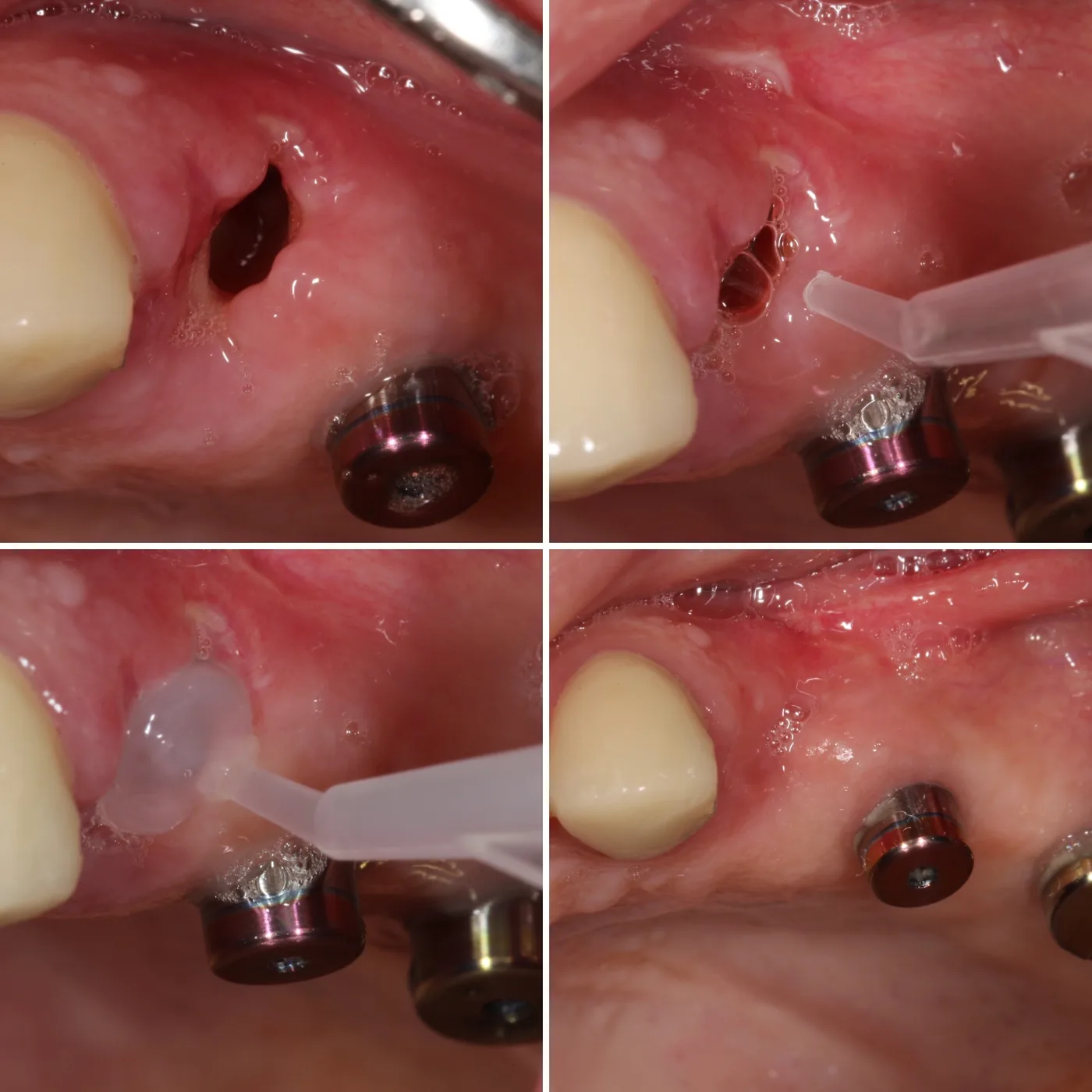
How the trials used it (study protocols, not a dosing recommendation): 0.4 mL of gel in the pocket for 3 minutes after instrumentation; 1.5 mL in an extraction socket; gel three times a day for 7 days after crown lengthening; mouthwash 10 mL twice a day for 2 weeks.
In our clinic, we use it on a regular basis, especially with titanium and ceramic implants. Supporting healing is a crucial part of caring for our patients.
What diabetes taught me about healing
Living with diabetes, you learn early that healing is never one factor. It is blood sugar, blood flow, a clean wound and time, all together.
An oxygen gel may be one small helper in that list, mostly in the first days of an open wound. The heavy work is still ours: clean the pocket, close the wound well, control the sugar, and come back to check.
That is what 35 studies taught us. If a better trial proves more, I will be the first to write about it.
If wound healing after gum surgery is your topic, read When the Connective Tissue Graft Was Too Good and Platelet-rich fibrin in dentistry.

Dr Dániel Végh, DMD, PhD, habil.
Prosthodontist · Implant Dentistry · VBV Dental, Győr, Hungary
Dr Dániel Végh is a prosthodontist and co-founder of VBV Dental in Győr, Hungary. His clinical work focuses on implant dentistry, full-mouth rehabilitation and digital workflows, with a particular interest in two-piece zirconia implants.
He graduated from Semmelweis University in 2015, completed his specialist training in conservative dentistry and prosthodontics in 2018, earned his PhD on the oral complications of diabetes in 2019, and obtained his habilitation in 2026. He worked at the university's Department of Prosthodontics from 2015 to 2026, serving as an Assistant Professor before moving into full-time private practice.
An ITI Scholar at the Medical University of Graz in 2021 to 2022, he also completed Harvard Medical School's Clinical Science Scholars programme. His research spans diabetes and oral health, ceramic implantology and digital dentistry. He serves on the Editorial Board of the International Dental Journal and remains actively involved in research, scientific publishing and diabetes advocacy.
- Prosthodontics
- Implant Dentistry
- Ceramic Implants
- Diabetes and Oral Health
- Digital Dentistry

Dr Gábor Kammerhofer, PhD
Oral surgeon · Semmelweis University
Dr Gábor Kammerhofer, PhD, is a specialist in oral surgery at the Department of Oro-Maxillofacial Surgery and Stomatology, Semmelweis University.
His research focuses on the relationship between medication-related osteonecrosis of the jaw (MRONJ) and hyperglycaemia, as well as the potential regenerative effects of oral gels, including NBF and Blue®M.
Frequently asked questions
Does an oxygen-releasing gel help healing after gum surgery?
On open, shallow wounds such as gingival depigmentation, small studies reported less pain in the first days and faster closure over the first two to three weeks compared with a periodontal dressing. By four weeks the results were the same. Most of these studies were at high risk of bias, and against hyaluronic acid gel there was no difference.
Does it improve the results of scaling and root planing?
Not in the best trial available. In 51 patients with poorly controlled type 2 diabetes, adding the gel to instrumentation gave no extra benefit after 180 days. Smaller trials with more risk of bias reported small extra pocket reduction.
Can the oxygen mouthwash replace chlorhexidine?
Trials found no significant difference, but none was designed to prove the two are equivalent. Patients reported less staining, burning and taste change with the oxygen rinse in two small trials at high risk of bias.
Is it safe?
Where side effects were assessed, the products were well tolerated. Most studies did not report side effects at all, so the safety record is incomplete.
Sources
- Nagy ÁT, Bogdán S, Joób-Fancsaly Á, Szabó G, Végh D, Németh Z, Kammerhofer G. Blue®M in dentistry: a narrative review of human clinical evidence and applications. Gels. 2026;12:954. doi:10.3390/gels12110954
- Cláudio MM, Garcia VG, Freitas RM, et al. Association of active oxygen-releasing gel and photodynamic therapy in the treatment of residual periodontal pockets in type 2 diabetic patients: a randomized controlled clinical study. J Periodontol. 2024;95:360-371. doi:10.1002/jper.23-0125
- Habib J, Shwaiki T. Comparative study of the effect of BlueM active oxygen gel and Coe-Pack dressing on postoperative surgical depigmentation healing. Saudi Dent J. 2022;34:328-334. doi:10.1016/j.sdentj.2022.04.005
- Dharmadhkari S, Rai P, Shetty G, et al. BlueM active oxygen gel versus Coe-Pak following scalpel gingival depigmentation: a split-mouth randomized clinical trial. Int J Drug Deliv Technol. 2026;16:1383-1390. doi:10.25258/ijddt.16.63s.137
- Garapati B, Ramamurthy J, Navya PD. Evaluation of the effects of antioxidant gel on the palatal graft donor site: a randomised controlled clinical trial. J Popul Ther Clin Pharmacol. 2023;30:e433-e441. doi:10.47750/jptcp.2023.30.10.048
- Grover M, Gupta A, Dubey T, et al. New age oxygen therapy for enhanced recovery: BLUE®M oral gel in post-extraction socket healing. J Dent Spec. 2025;13:131-137. doi:10.18231/j.jds.2025.020
- Vyas R, Kumar S, Manasa CM. Blue®m gel vs hyaluronic acid gel in wound healing and pain control following functional crown lengthening: a randomized controlled trial. Saudi Dent J. 2026;38:65. doi:10.1007/s44445-026-00178-4
- Kumar M, Meher BR, Mishra L, et al. Evaluation of Blue®m mouthwash versus chlorhexidine mouthwash in patients with gingivitis: a pilot study. Appl Sci. 2024;14:11862. doi:10.3390/app142411862
- Mahesh L, Bhasin M, Rathi N. Evaluation of oxygen-releasing mouthwash and chlorhexidine as adjuncts in gingivitis treatment: a randomized controlled trial. Bioinformation. 2026;22:1684-1688. doi:10.6026/973206300221684
- Teixeira TC, Ribeiro RAG, Mascella V, Deliberador TM. Comparison of Blue®m and chlorhexidine mouthwash on oral health of intubated patients in intensive care unit. Braz Dent J. 2025;36:e25-6537. doi:10.1590/0103-644020256537
- Ashref A, Gajendran P, Nesappan T. Comparative evaluation of the clinical efficacy of oxygen enriched mouthwash and chlorhexidine mouthwash in patients undergoing dental implant placement. J Odontol. 2022;6:609.
- Custódio CP, Freitas RM, Marcantonio Junior E, et al. Effects of an oxygen-releasing mouthwash for peri-implant health management: a pilot randomized controlled clinical trial. Rev Odontol UNESP. 2024;53:e20240021. doi:10.1590/1807-2577.02124
- blue®m for professionals. bluemcare.com/for-professionals (accessed 24 Oct 2026). Open
Disclosure
Dr Végh and Dr Kammerhofer are co-authors of the review this article is based on. The review authors declare that neither they nor their institutions received products, money or any other support from the manufacturer for the review. Dr Kammerhofer has no affiliation with bluem and has received no support from the company.
bluem supports Periospot's Top Dentists 2026 board with product packs for the three winners. bluem did not pay for this article and did not see it before publication.