
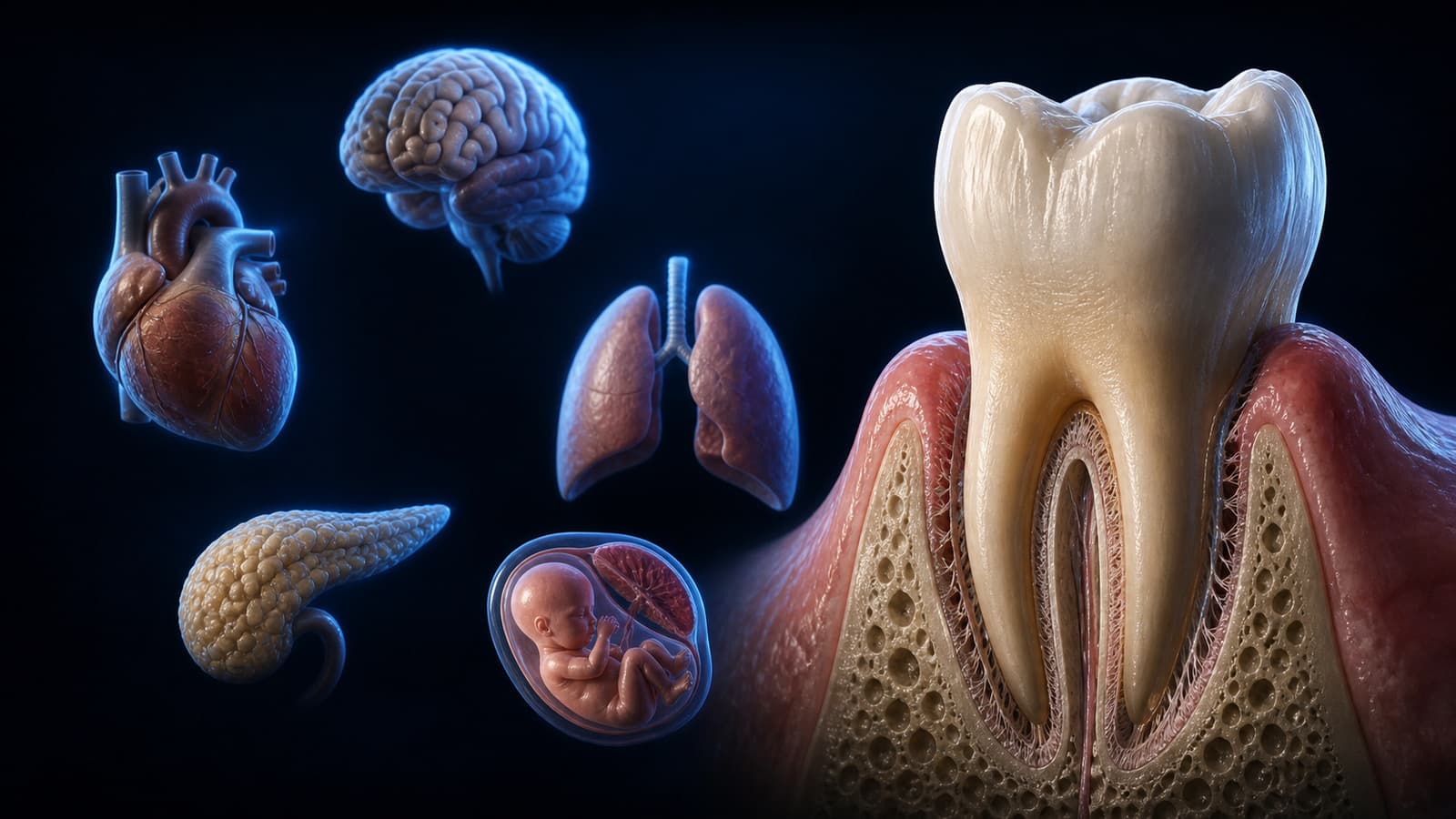
Spend enough time on dental Instagram and you could leave believing that periodontitis is responsible for half of medicine.
Diabetes. High blood pressure. Heart attacks. Dementia. Premature birth. Lung disease. The list grows every month.
I have made several of those videos myself. I make them because the mouth is not separate from the rest of the body, and because dentists should understand the medical context of the disease they treat. But I also know how easily one important phrase disappears as a paper becomes a headline:
“Associated with” is not the same as “caused by.”
By the time the finding reaches a patient, “people with periodontitis had more cardiovascular events” can quietly become “gum disease causes heart attacks.” That is a much bigger claim. Usually, the study was never designed to prove it.
My view is less dramatic and more useful: the oral–systemic connection is real, but every connection does not carry the same evidential weight.
The short answer
Periodontitis and systemic disease can appear together because one contributes to the other, because they share causes, or because bias and measurement error distort the picture. Several explanations may be operating at once.
A current umbrella review examined 24 systematic reviews covering 32 noncommunicable diseases. The reported associations ranged from strong to absent, while the certainty of evidence was generally low or very low. There is enough signal to take the subject seriously. There is not enough certainty to use the same causal sentence for every disease (Rodríguez-Medina et al., 2025).
That leaves us with a practical rule: count the rung before you choose the verb.
The evidence field
A link is the beginning of the question, not the end.
One umbrella review mapped a large field. The useful clinical task is deciding how far each disease relationship has climbed.
The six-rung test
- 1
Does the association repeat?
Across populations, definitions, and research teams—not only in one dataset.
- 2
Does the exposure come first?
Temporality narrows the story, although it does not remove confounding.
- 3
Is there a plausible mechanism?
Biology can explain a result; it cannot, by itself, prove a clinical effect.
- 4
Does causal inference agree?
Triangulation methods should point in a compatible direction and survive assumptions.
- 5
Does treatment change an intermediate outcome?
HbA1c, blood pressure, and CRP matter, but they are not hard clinical events.
- 6
Does treatment prevent hard outcomes?
The final claim needs fewer myocardial infarctions, strokes, complications, or preterm births.
What randomized evidence changes—and what it does not
HbA1c at 3–4 months
−0.43 percentage points
95% CI −0.59 to −0.28
Pooled short-term intermediate outcome; substantial heterogeneity (I² 71%).
Systolic blood pressure
−4.64 mmHg
95% CI −5.99 to −3.30
Intermediate outcome with moderate-to-low certainty; not evidence of fewer cardiovascular events.
Preterm birth
RR 0.85
95% CI 0.71 to 1.02
The interval crosses the null value 1.0 and remains compatible with no benefit.
Disease-by-disease evidence matrix
The columns are not interchangeable.
Status is written out so the chart does not rely on color alone.
| Disease | Association | Intervention / surrogate | Hard outcomes |
|---|---|---|---|
| Diabetes | Observational association | Intermediate-outcome evidence | Hard-outcome prevention not established |
| Cardiovascular disease | Observational association | Intermediate-outcome evidence | Hard-outcome prevention not established |
| Pregnancy outcomes | Observational association | Mixed evidence; latest pooled estimate moderate certainty | Hard-outcome prevention not established |
| Dementia | Observational association | No established intervention effect | Hard-outcome prevention not established |
| Inflammatory bowel disease | Directionally asymmetric association | No established intervention effect | Hard-outcome prevention not established |
| COPD | Association weakens after smoking control | No established intervention effect | Hard-outcome prevention not established |
1. Diabetes: the most clinically actionable relationship
If I had to choose one oral–systemic relationship that already changes daily periodontal care, it would be diabetes.
The corrected 2026 replacement article, issued through a formal retraction-and-republication, included 28 prospective longitudinal studies from 16 countries and more than 300,000 participants. Periodontitis at baseline was associated with an 18% to 25% higher occurrence of newly incident type 2 diabetes. Diabetes at baseline was also associated with later periodontitis, although those estimates were modest and more imprecise. An earlier independent cohort meta-analysis found similarly modest associations in both directions, with substantial unexplained heterogeneity. Together, these findings support a bidirectional temporal association—not proof of reciprocal causation (Botelho et al., 2026; Stöhr et al., 2021).
The intervention evidence is more useful clinically. A Cochrane review included 35 randomized trials and 3,249 participants. At three to four months, 30 trials with 2,443 analyzed participants found that periodontal treatment reduced HbA1c by a pooled average of 0.43 percentage points compared with no active treatment or usual care (95% CI −0.59 to −0.28). Between-trial heterogeneity was substantial (I² = 71%), so this is not an individual-patient prediction. At six months the estimate was smaller—0.30 percentage points (95% CI −0.52 to −0.08)—and heterogeneity was higher (I² = 80%). Evidence beyond that was sparse (Simpson et al., 2022).
Notice the endpoint: HbA1c. It is a clinically relevant surrogate, but these trials did not show that periodontal treatment replaces glucose-lowering medication or prevents the long-term complications of diabetes.
What should change in clinic?
- Ask about diabetes status and recent HbA1c when it is relevant.
- Explain that hyperglycemia can make periodontal control more difficult.
- Coordinate with the patient’s physician when undiagnosed or poorly controlled diabetes is plausible.
- Describe periodontal treatment as part of good diabetes care, never as a substitute for it.
That is already meaningful. We do not need to inflate it.
2. Cardiovascular disease: a pooled signal and a seductive conclusion
Cardiovascular disease is where causal language becomes especially tempting.
A 2023 meta-analysis included 39 cohort studies—29 prospective and 10 retrospective—with 4,389,263 participants. Periodontal disease was associated with more major adverse cardiovascular events (RR 1.24, 95% CI 1.15–1.34), myocardial infarction (RR 1.14, 95% CI 1.06–1.22), and stroke (RR 1.26, 95% CI 1.15–1.37) (Guo et al., 2023).
Those pooled estimates were positive, but between-study heterogeneity was substantial: I² was 88.9% for major adverse cardiovascular events, 80.1% for myocardial infarction, and 94.8% for stroke. Periodontal definitions, cardiovascular endpoints, adjustment, and study design varied. The estimates do not mean that an individual patient’s 6 mm pocket caused a stroke.
The same problem appears with hypertension. I unpacked that literature in more detail in this article on gum disease and blood pressure.
Then the blood-pressure trials change the question. A 2026 meta-analysis pooled 12 randomized trials and reported that periodontal therapy reduced systolic blood pressure by 4.64 mmHg (95% CI −5.99 to −3.30), diastolic blood pressure by 1.84 mmHg (95% CI −2.65 to −1.02), and C-reactive protein by 0.58 mg/L (95% CI −0.83 to −0.33). The certainty was moderate to low, and the authors called for trials powered specifically for blood-pressure outcomes (Gandhi et al., 2026).
That final distinction matters. A blood-pressure shift is not a heart attack prevented.
A 2024 review of Mendelian-randomization studies did not support a causal effect of periodontitis on atherosclerotic cardiovascular disease (Kim et al., 2024). A broader 2026 synthesis was not uniformly null: it reported a borderline signal for cardioembolic stroke (OR 1.03, 95% CI 1.00–1.05), while finding no substantial causal signal for overall stroke or coronary atherosclerosis. Only three stroke studies contributed, and the result remains sensitive to instrument strength, phenotype quality, and the predominance of European genetic data (Zhao et al., 2026).
That is a result to watch, not a verdict—and certainly not evidence that periodontal therapy prevents stroke.
The honest patient message is: periodontal disease and cardiovascular disease travel together more often than we would like, so prevention, diagnosis, and medical coordination matter. We cannot currently promise that periodontal treatment will prevent a cardiovascular event.
3. Pregnancy: when association does not become a prevention promise
Pregnancy is perhaps the cleanest example of why observational evidence and treatment evidence must be separated.
An overview of 23 systematic reviews found that the reviews at the lowest risk of bias still reported associations between maternal periodontitis and preterm birth (RR 1.6, 95% CI 1.3–2.0), low birth weight (RR 1.7, 95% CI 1.3–2.1), and pre-eclampsia (OR 2.2, 95% CI 1.4–3.4) (Daalderop et al., 2018).
Then we intervene—and the message becomes narrower. The 2017 Cochrane review found no clear reduction in preterm birth before 37 weeks (RR 0.87, 95% CI 0.70–1.10; low-certainty evidence), while a 2024 network meta-analysis produced encouraging estimates for several multicomponent periodontal protocols but judged every preterm-birth comparison low or very low certainty (Iheozor-Ejiofor et al., 2017; Wu et al., 2024).
The most current review included 14 randomized trials and 8,316 participants. It estimated RR 0.85 for preterm birth (95% CI 0.71–1.02), or 20 fewer preterm births per 1,000 people, with a 95% CI from 39 fewer to 3 more. In plain English: Treatment may produce a modest reduction, but prevention is not established because the interval remains compatible with no benefit (Thomas et al., 2026).
This does not make periodontal care during pregnancy unimportant. Scaling and root planing are considered safe when clinically indicated (American Dental Association [ADA], 2025). It makes the promise narrower: we should not tell a pregnant patient that periodontal treatment has been proven to prevent preterm birth.
4. Dementia: when the arrow may point backward
Poor periodontal health is associated with later cognitive decline. The difficult question is what the association means.
A systematic review of 47 longitudinal studies reported associations with cognitive decline (OR 1.23, 95% CI 1.05–1.44) and dementia (HR 1.21, 95% CI 1.07–1.38). The authors rated the overall evidence as low quality and judged that reverse causality probably explained part of the relationship. The exposure definitions also mixed periodontitis, tooth loss, deep pockets, and bone loss, which are not interchangeable (Asher et al., 2022).
A 2026 umbrella review makes the certainty problem even clearer: 12 of its 14 included reviews were judged at high risk of bias, and GRADE certainty for mild cognitive impairment, Alzheimer disease, and dementia was very low (Rizwan Ali et al., 2026).
Reverse causation is not an abstract statistical problem here. Early cognitive deterioration can reduce brushing quality, dental attendance, nutrition, and the ability to manage complex care long before a formal diagnosis. Brushing also travels with education, income, dexterity, exercise, diet, smoking, and access to healthcare. A cohort can adjust for the variables it measured. It cannot adjust perfectly for everything that makes one person brush more often than another.
A 2024 Mendelian-randomization analysis did not support a causal effect of periodontitis on Alzheimer disease. Again, “did not support” is the correct phrase. One method cannot close the case (Hu et al., 2024).
What does this change in practice? Maintaining oral function and making dental care easier for people with cognitive impairment matters. It is not honest to market toothbrushing or periodontal therapy as proven dementia prevention.
5. The oral–gut axis: directionality is not always symmetrical
The oral–gut axis is biologically fascinating. It is also a place where a mechanism can run ahead of clinical proof.
A directionality-focused review examined whether periodontitis preceded inflammatory bowel disease and whether inflammatory bowel disease preceded periodontitis. For periodontitis to overall IBD, four longitudinal studies covering more than 10 million records produced no clear association (RR 1.04, 95% CI 0.99–1.09). There was a small association with ulcerative colitis (RR 1.12, 95% CI 1.04–1.21), but not Crohn disease (RR 0.98, 95% CI 0.92–1.04).
In the opposite direction, two studies found that IBD was associated with later periodontitis (HR 1.37, 95% CI 1.26–1.49) (Wang et al., 2024).
This is a good reminder that an enormous sample does not, by itself, eliminate exposure misclassification or residual confounding. The oral–gut pathway is plausible. We do not yet have evidence that treating periodontitis treats IBD, or vice versa.
6. COPD: how a shared cause can imitate a direct relationship
Smoking is a major risk factor for both periodontitis and chronic obstructive pulmonary disease. If smoking exposure is measured crudely, the two diseases can appear more directly connected than they are.
A 2023 review of 22 observational studies and 51,704 participants found a broad association between periodontal disease and COPD (OR 1.20, 95% CI 1.09–1.32). After studies adjusted more rigorously for smoking intensity, the association was no longer clear (OR 1.14, 95% CI 0.86–1.51). The analysis also found no clear association in smokers or never-smokers considered separately (Yang et al., 2023).
That does not make oral care unimportant for a patient with COPD. It means this evidence does not establish periodontal disease as an independent cause of COPD—or periodontal treatment as COPD therapy.
This is confounding in its most clinically recognizable form: a shared cause can imitate a direct relationship.
What should we actually tell patients?
A patient-friendly explanation is:
“These conditions appear together more often in observational studies. That does not prove that one caused the other. The good news is that your periodontal disease is treatable for important oral-health reasons, and in some conditions—especially diabetes—treatment may also support a measurable systemic outcome.”
Then make the message disease-specific.
- Diabetes: Ask about control, coordinate care, and explain the modest short-term HbA1c evidence.
- Cardiovascular disease and hypertension: Recognize shared risk, encourage appropriate medical follow-up, and do not promise event prevention.
- Pregnancy: Provide indicated periodontal care without claiming it will prevent preterm birth.
- Cognitive impairment: Simplify maintenance and involve caregivers when appropriate; do not sell dementia prevention.
- IBD and COPD: Consider the medical context without inventing a proven treatment effect.
Most importantly, diagnose periodontitis properly. “Poor oral health,” gingivitis, tooth loss, self-reported gum disease, and stage III periodontitis are not the same exposure. If a paper combines them, its headline should not become more precise than its methods.
Questions dentists ask me
Does gum disease cause heart disease?
Periodontitis is associated with cardiovascular events in observational research, but the studies are heterogeneous and share major confounders. Randomized treatment studies report changes in some intermediate outcomes; they have not established that periodontal treatment prevents myocardial infarction, stroke, or cardiovascular death.
Can treating periodontitis improve blood sugar?
In people who have both diabetes and periodontitis, a 2022 Cochrane review found a pooled HbA1c reduction of 0.43 percentage points at three to four months. The response varies, heterogeneity was substantial, and periodontal care does not replace medical diabetes treatment.
Can periodontal treatment prevent preterm birth?
A 2026 synthesis estimated RR 0.85, with a 95% confidence interval from 0.71 to 1.02. That is compatible with a modest benefit and with no benefit. Treatment is appropriate for oral-health indications during pregnancy, but prevention of preterm birth is not established.
What does association versus causation mean?
Association means two findings occur together more often than expected. Causation means changing one changes the other, after alternative explanations such as smoking, diabetes, age, medication, and access to care have been addressed.
Should oral-systemic links change daily dental practice?
They should sharpen screening, medical-history review, interdisciplinary communication, and honest patient explanations. They do not justify promising that periodontal treatment will prevent a systemic disease unless hard-outcome evidence supports that claim.
The final point
We do not need weak causal headlines to make periodontology important.
Periodontitis already matters because it destroys attachment and bone, threatens tooth retention, affects function and quality of life, and requires long-term control. Oral–systemic evidence adds another responsibility: it should make us better at risk detection, patient communication, and interdisciplinary care.
The mouth is connected to the body. The evidence is connected too—from association, to temporality, to mechanism, to intervention, to outcomes.
Our job is not to stop at the most exciting rung.
Our job is to tell patients exactly how high the evidence has climbed.
References
- American Dental Association. (2025, July 14). Pregnancy. https://www.ada.org/resources/ada-library/oral-health-topics/pregnancy
- Asher, S., Stephen, R., Mäntylä, P., Suominen, A. L., & Solomon, A. (2022). Periodontal health, cognitive decline, and dementia: A systematic review and meta-analysis of longitudinal studies. Journal of the American Geriatrics Society, 70(9), 2695–2709. https://doi.org/10.1111/jgs.17978
- Botelho, J., Singh, S., Varenne, B., Rendell, N., Harada, Y., Proença, L., Machado, V., & Valentim Bitencourt, F. (2026). Oral health and diabetes: A systematic review and meta-analysis. The Lancet Public Health, 11(8), e555–e566. https://doi.org/10.1016/S2468-2667(26)00149-0
- Daalderop, L. A., Wieland, B. V., Tomsin, K., Reyes, L., Kramer, B. W., Vanterpool, S. F., & Been, J. V. (2018). Periodontal disease and pregnancy outcomes: Overview of systematic reviews. JDR Clinical & Translational Research, 3(1), 10–27. https://doi.org/10.1177/2380084417731097
- Gandhi, K. K., Batra, C., & Affendi, H. (2026). Cardiovascular and anti-inflammatory effects of periodontal therapy: A systematic review and meta-analysis of randomized trials. Journal of Periodontology. Advance online publication. https://doi.org/10.1002/jper.70162
- Guo, X., Li, X., Liao, C., Feng, X., & He, T. (2023). Periodontal disease and subsequent risk of cardiovascular outcome and all-cause mortality: A meta-analysis of prospective studies. PLOS ONE, 18(9), e0290545. https://doi.org/10.1371/journal.pone.0290545
- Hu, C., Li, H., Huang, L., Wang, R., Wang, Z., Ma, R., Chang, B., Li, S., Li, H., & Li, G. (2024). Periodontal disease and risk of Alzheimer’s disease: A two-sample Mendelian randomization. Brain and Behavior, 14(4), e3486. https://doi.org/10.1002/brb3.3486
- Iheozor-Ejiofor, Z., Middleton, P., Esposito, M., & Glenny, A.-M. (2017). Treating periodontal disease for preventing adverse birth outcomes in pregnant women. Cochrane Database of Systematic Reviews, 2017(6), CD005297. https://doi.org/10.1002/14651858.CD005297.pub3
- Kim, J. Y., Lee, K., Lee, M. G., & Kim, S.-J. (2024). Periodontitis and atherosclerotic cardiovascular disease. Molecules and Cells, 47(12), 100146. https://doi.org/10.1016/j.mocell.2024.100146
- Rizwan Ali, A., Kumar, P., Patnana, A. K., Shanmugam, S., Chugh, A., & Chaudhry, K. (2026). Association between periodontitis and mild cognitive impairment, Alzheimer’s disease, and dementia: An umbrella review with evidence stratification. Special Care in Dentistry, 46(4), e70235. https://doi.org/10.1111/scd.70235
- Rodríguez-Medina, C., Amaya Sánchez, S., Contreras, A., & Botero, J. E. (2025). Grading the strength and certainty of the scientific evidence of the bidirectional association between periodontitis and noncommunicable diseases: An umbrella review. Evidence-Based Dentistry, 26(3), 147. https://doi.org/10.1038/s41432-025-01132-9
- Simpson, T. C., Clarkson, J. E., Worthington, H. V., MacDonald, L., Weldon, J. C., Needleman, I., Iheozor-Ejiofor, Z., Wild, S. H., Qureshi, A., Walker, A., Patel, V. A., Boyers, D., & Twigg, J. (2022). Treatment of periodontitis for glycaemic control in people with diabetes mellitus. Cochrane Database of Systematic Reviews, 2022(4), CD004714. https://doi.org/10.1002/14651858.CD004714.pub4
- Stöhr, J., Barbaresko, J., Neuenschwander, M., & Schlesinger, S. (2021). Bidirectional association between periodontal disease and diabetes mellitus: A systematic review and meta-analysis of cohort studies. Scientific Reports, 11(1), 13686. https://doi.org/10.1038/s41598-021-93062-6
- Thomas, C., Ahmed, S., Berghella, V., Brignardello-Petersen, R., El-Rabbany, M., Devion, C., & Ronzoni, S. (2026). Effect of dental treatments on reduction of preterm birth: A systematic review and meta-analysis. American Journal of Obstetrics & Gynecology MFM, 8(3), 101884. https://doi.org/10.1016/j.ajogmf.2025.101884
- Wang, Q., Chen, S., Zhou, J., & Zhao, L. (2024). Bidirectional associations between periodontitis and inflammatory bowel disease: A systematic review of longitudinal studies with meta-analysis and trial sequential analysis. Journal of Periodontal Research, 59(6), 1083–1094. https://doi.org/10.1111/jre.13291
- Wu, J., Wu, J., Tang, B., Zhang, Z., Wei, F., Yu, D., Li, L., Zhao, Y., Wang, B., Wu, W., & Hong, X. (2024). Effects of different periodontal interventions on the risk of adverse pregnancy outcomes in pregnant women: A systematic review and network meta-analysis of randomized controlled trials. Frontiers in Public Health, 12, 1373691. https://doi.org/10.3389/fpubh.2024.1373691
- Yang, M., Peng, R., Li, X., Peng, J., Liu, L., & Chen, L. (2023). Association between chronic obstructive pulmonary disease and periodontal disease: A systematic review and meta-analysis. BMJ Open, 13(6), e067432. https://doi.org/10.1136/bmjopen-2022-067432
- Zhao, Y., Zhang, C., Chang, X., Zhang, J., Shu, C., Lin, C., & Hou, J. (2026). Causal association between periodontitis and systemic diseases: A systematic review and meta-analysis of Mendelian randomization studies. BMC Oral Health, 26(1), 383. https://doi.org/10.1186/s12903-026-07725-9
Educational content only. It does not replace patient-specific medical or dental assessment.