Premium Presenter Kit
Lecture-ready Periospot and Tuminha presentation decks for yearly members and monthly Pro and Ultimate members: editable text, real slide previews, and gated PowerPoint downloads.
47
Download-ready decks
395
Real slide previews
47
Editable PPTX files
CTG Donor Site Biology
Editable lecture deck explaining why palatal and tuberosity connective tissue grafts are not biologically identical.
Use when discussing graft selection, donor-site biology, recipient-site demands, and clinical decision making.
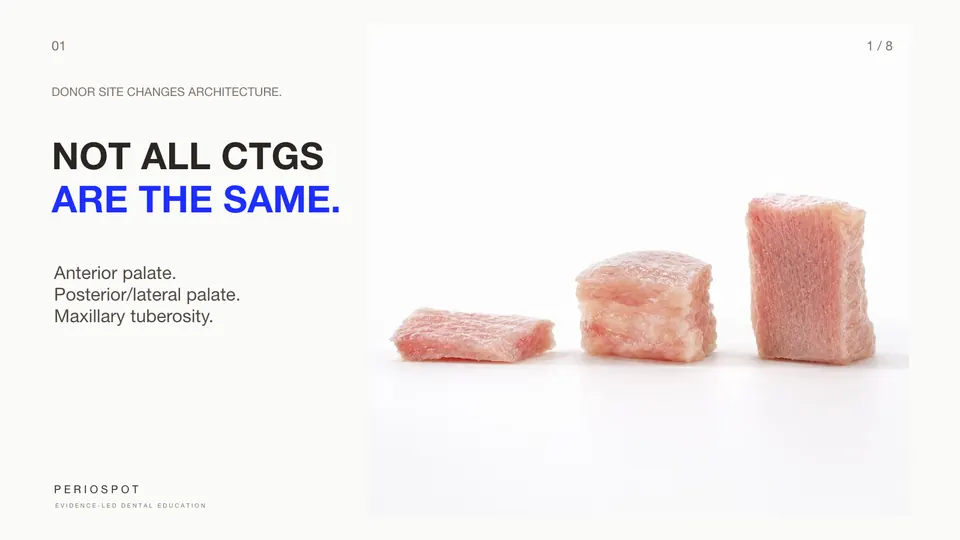
Slide 1 of 8: Not all CTGs are the same.
Anterior palate, posterior lateral palate, and maxillary tuberosity can differ in tissue architecture.
Your Mouth Can Break Your Heart
Use for the oral–systemic link: honest about association vs causation.

Slide 1 of 6: Slide 1
Editable slide exported from the deck.
Antibiotics in Peri-Implantitis
When adjunctive systemic antibiotics do and do not change peri-implantitis outcomes.
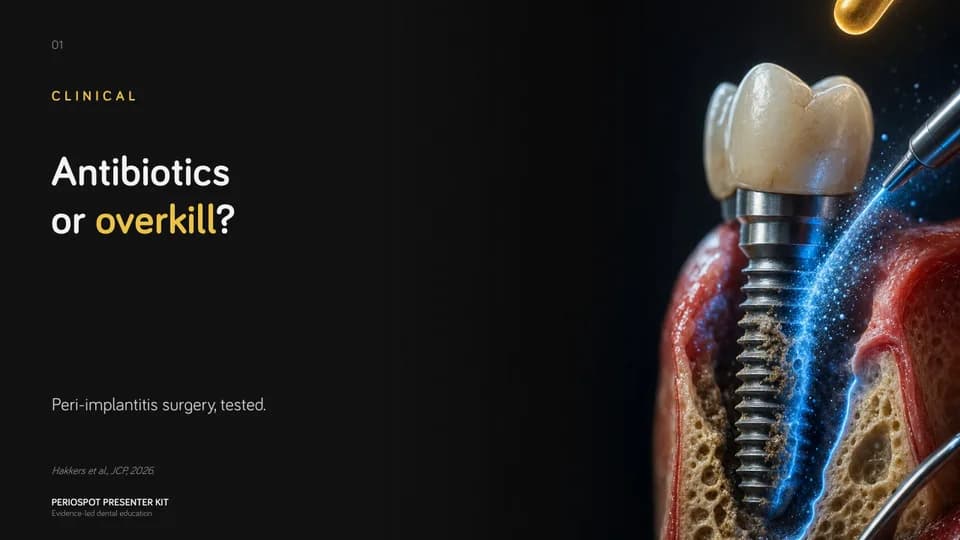
Slide 1 of 9: Slide 1
Editable slide exported from the deck.
Gums as a Whole-Body Signal
Periodontal status as a systemic-health signal.
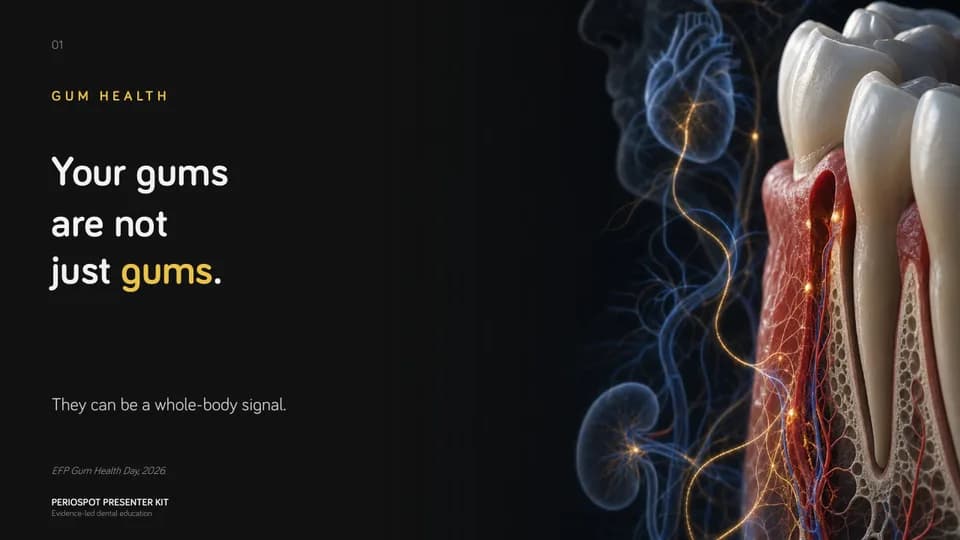
Slide 1 of 9: Slide 1
Editable slide exported from the deck.
Cow Bone vs Lab Bone
Xenograft vs synthetic graft behaviour and selection.
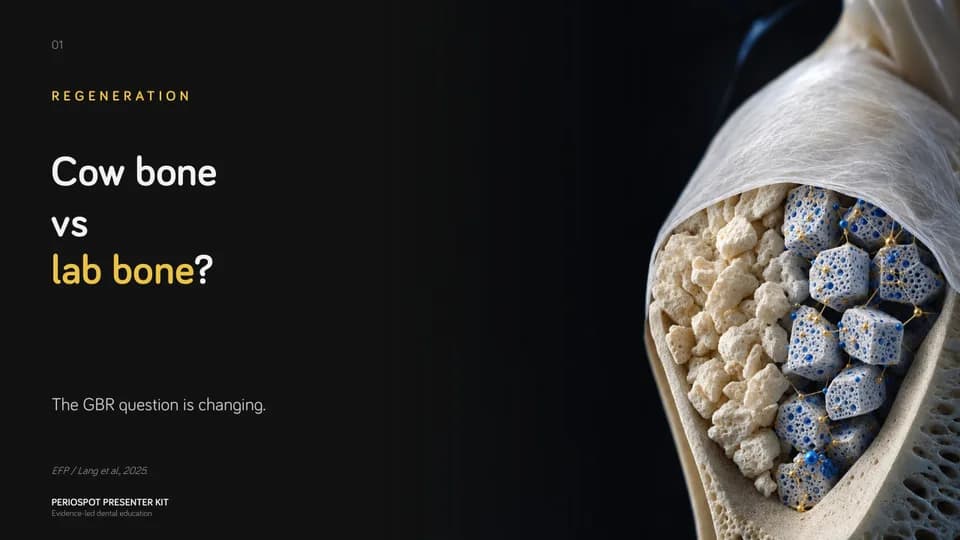
Slide 1 of 9: Slide 1
Editable slide exported from the deck.
The Implant Does Not Fail Alone
Peri-implant tissue as the first line of failure.
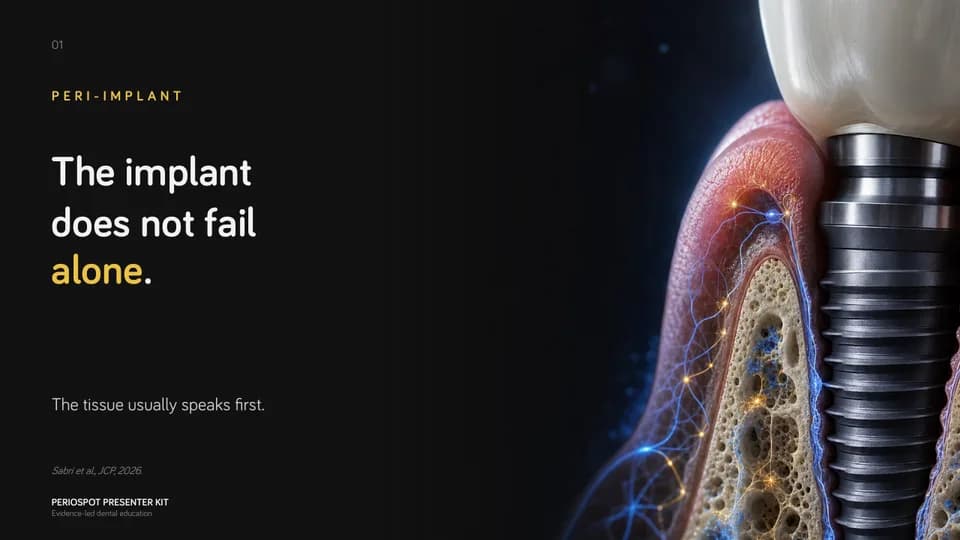
Slide 1 of 9: Slide 1
Editable slide exported from the deck.
AI as the Second Periodontal Examiner
AI as a second set of eyes in periodontal diagnosis — useful, not autonomous.
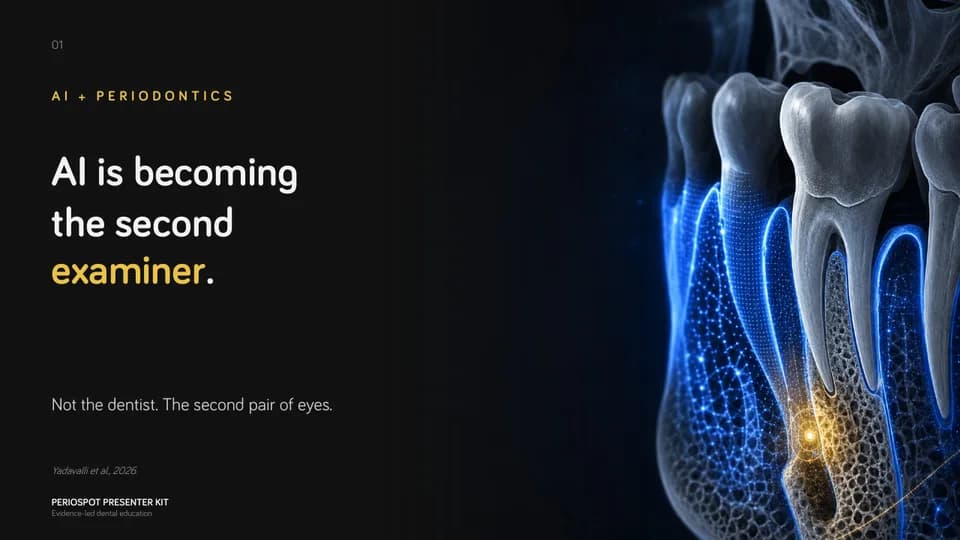
Slide 1 of 9: Slide 1
Editable slide exported from the deck.
Prosthetic Design Is Biology
Why prosthetic/emergence design is a biological decision.
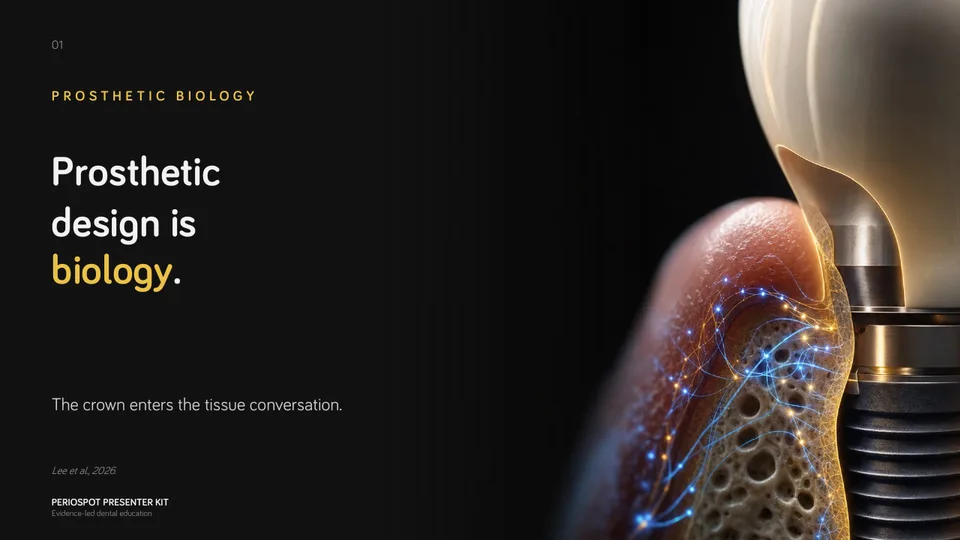
Slide 1 of 9: Slide 1
Editable slide exported from the deck.
Before You Build Bone, Find the Artery
Why mandibular vertical ridge augmentation starts with the sublingual artery and floor-of-mouth anatomy, not the graft.
Use before mandibular VRA to map the lingual arterial risk before grafting.
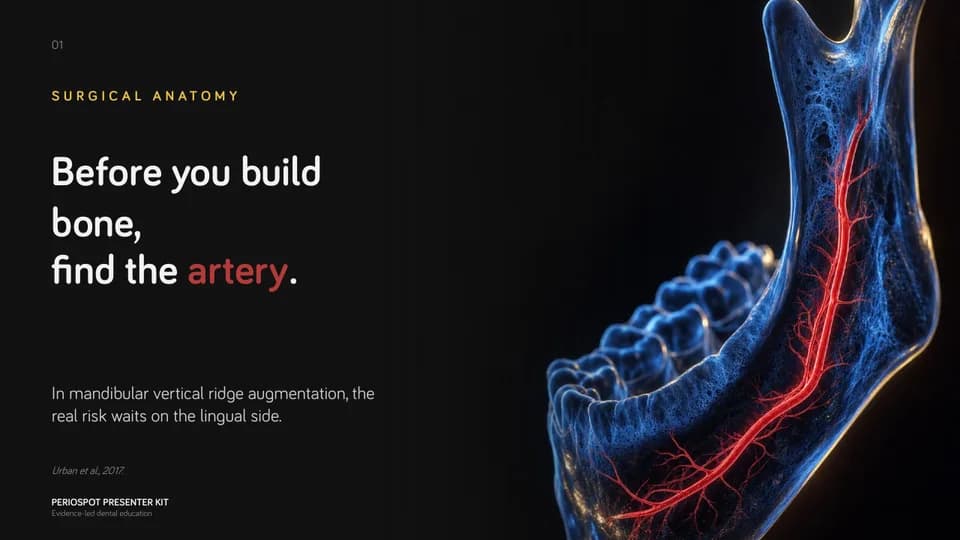
Slide 1 of 6: Slide 1
Editable slide exported from the deck.
Mandibular VRA: Find the Artery
The Tuminha_dds white-style deck on mandibular vertical ridge augmentation and the lingual/sublingual artery risk.
Map the floor of mouth before mandibular VRA — the lingual artery risk, in the clean white style.
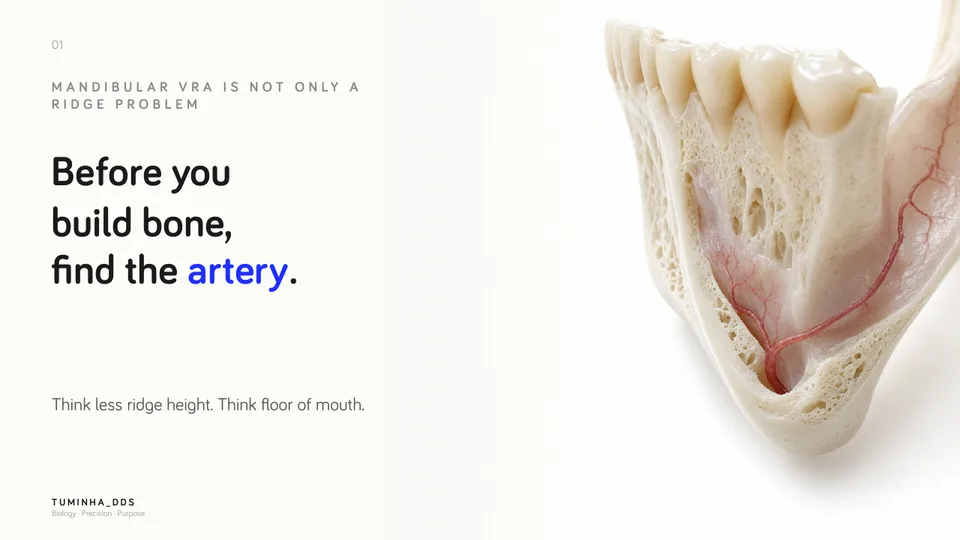
Slide 1 of 8: Slide 1
Editable slide exported from the deck.
Short Implants Having A Moment
Editable Presenter Kit deck based on the Jun 11 Periospot carousel about 6-mm posterior implants, case selection, survival data, mechanical complications, and maintenance.
Use short implants as disciplined posterior planning decisions, not shortcuts.

Slide 1 of 10: A 6-mm implant is not a shortcut
A disciplined posterior solution when anatomy and prosthetic planning support it.
The Socket Does Not Heal Flat
Editable Presenter Kit deck based on the Jun 11 Tuminha DDS carousel about socket healing architecture after extraction.
Use socket healing histology as a mental model for how architecture changes over time, without turning animal histology into human implant-timing advice.

Slide 1 of 8: The socket does not heal flat
After extraction, the socket changes shape, tissue identity, and speed.
Peri-Implant Mucosa Defense Architecture
Editable Presenter Kit deck based on the Jun 18 Tuminha DDS carousel about the peri-implant mucosa as a biologic defense wall.
Use the human histology of peri-implant mucosa to teach why the transmucosal zone is a real but non-periodontal-ligament seal.

Slide 1 of 8: Slide 1
Editable slide exported from the deck.
Implant Stability: Biology Must Agree
Editable Presenter Kit deck based on the Jun 16 Periospot carousel about torque, primary stability, and the biological interface.
Use torque as a starting signal, not a success label; teach controlled stability with a tissue interface that can heal.

Slide 1 of 10: Slide 1
Editable slide exported from the deck.
Fusobacterium, Breast Cancer, and the Caveat
Editable Presenter Kit deck based on the Jun 14 Periospot carousel about Fusobacterium nucleatum inside breast cancer cells and the clinical caveat.
Use oral-systemic oncology signals without overclaiming causation or prevention.

Slide 1 of 10: Slide 1
Editable slide exported from the deck.
The Gap Is Not Empty
A lecture-ready deck about immediate implant jumping gaps as biologic wound decisions, not only millimeter measurements.
Use to teach immediate implant gap planning with the honest guardrail that grafting does not cancel extraction biology.

Slide 1 of 10: Slide 1
Editable slide exported from the deck.
Immediate Loading Histology Case
Editable deck from Guida et al.'s human histologic case report comparing loaded and unloaded immediate implants after six months.
Use to discuss immediate loading as a controlled biological question, not a dogma.

Slide 1 of 8: One loaded implant. Then the histology talked.
One human case report. A useful signal, not a rule.
ISQ Is a Healing Curve
ISQ is a healing curve, not a single number. At placement it reflects primary mechanical stability; during healing, biology revises it. Read the trend with torque, bone quality, surgical protocol, symptoms, tissue response, and the prosthetic plan.
Teach implant stability as a trend, not a threshold: why one ISQ reading should not drive loading, delay, panic, or celebration.

Slide 1 of 8: ISQ is not one number. It is a healing curve.
At placement it is a snapshot. Through healing it becomes a trend.
Crown Contour and Peri-Implant Probing
A clinical deck on how prosthetic contour and access influence peri-implant probing depth and diagnostic interpretation.
Use this to teach access-aware peri-implant exams: document contour, inflammation, baseline radiographs, and remove prostheses only when uncertainty changes care.

Slide 1 of 8: Are you probing the pocket or the crown?
Prosthetic contour can hide almost 1 mm of probing depth.
Peri-Implant Bone Loss Is Not Just Millimeters
A clinical deck on reading peri-implant bone defect architecture before planning regenerative treatment.
Use this to move the discussion from defect depth alone to morphology, containment, wall configuration, and realistic regenerative expectations.

Slide 1 of 8: Bone loss is not just a number.
The defect has architecture. Depth is only one axis.
Can We Treat the Host, Not Only the Biofilm?
Editable Presenter Kit deck from the July 27 Periospot carousel on host modulation after instrumentation.
Use the one-year randomized trial to discuss when systemic adjuncts should earn their place after biofilm disruption.

Slide 1 of 8: Can we treat the host, not only biofilm?
A 2026 randomized trial reopens the adjunct question.
Fenestration Or Dehiscence
Editable Presenter Kit deck from the July 28 Tuminha carousel distinguishing fenestration from dehiscence.
Use the crestal bridge distinction to connect CBCT interpretation with clinical diagnosis.

Slide 1 of 8: Fenestration or dehiscence?
Two bone defects. One crestal difference.
Periodontal Therapy and Blood Pressure
A source-grounded review of the pooled blood-pressure signal after periodontal therapy and the limits of that evidence.
Separate pooled surrogate changes from individual prediction, cardiovascular events, and antihypertensive treatment.

Slide 1 of 9: Periodontal therapy: -4.64 mmHg pooled systolic difference.
Versus control, across 12 randomized trials.
Nasopalatine Canal Anatomy
An editable anatomy deck for planning anterior maxillary implants around the nasopalatine canal.
Map canal morphology, ridge resorption, neurovascular contents, and implant trajectory before treating the canal as available space.

Slide 1 of 8: That canal is not empty.
The anterior maxilla contains a three-dimensional neurovascular corridor.
Cervical Enamel Projections and the Furcation
A cervical enamel projection extends apically from the CEJ toward a molar furcation. The 3.1 mm versus 0.7 mm values come from one ex-vivo micro-CT study of 50 permanent mandibular first molars. Historic Grade II/III findings are an association with furcation involvement, not proof that every projection causes periodontitis. Visuals are conceptual teaching renders, not specimen or grade morphology.
Use for molar furcation anatomy with careful claim boundaries: one micro-CT sample, association not causation, and conceptual visuals rather than specimen-grade representations.

Slide 1 of 8: Enamel can cross the CEJ boundary
A cervical enamel projection extends apically from the cementoenamel junction toward a molar furcation. Visuals in this deck are conceptual teaching renders, not specimen or grade morphology.
Diabetes and Periodontitis
Periodontitis and diabetes are clinically linked, but the deck should avoid simple two-way causal wording. A 2022 Cochrane review in mostly type 2 diabetes found periodontal treatment was associated with a mean HbA1c difference of -0.43 percentage points at 3 to 4 months versus no treatment or usual care across 30 studies and 2,443 participants, 95% CI -0.59 to -0.28, moderate certainty. Longer-term durability is less certain.
Use for a disciplined diabetes-periodontitis discussion: association, shared inflammatory and care context, short-term HbA1c mean difference, limited durability, and coordination with medical care without presenting periodontal treatment as glycaemic therapy by itself.

Slide 1 of 7: Diabetes and periodontitis are clinically linked
The relationship matters, but it should not be framed as a simple two-way causal loop.
Abrasive vs Nonabrasive Implant Cleaning
A 2026 randomized trial compared abrasive titanium scalers with a nonabrasive rotary polymer microbrush during staged reconstructive peri-implantitis therapy, with better 12-month resolution, bone gain and probing-depth reduction in the nonabrasive arm.
Use to argue instrument choice in peri-implantitis decontamination: better outcomes with nonabrasive cleaning, while staying honest that the trial was small and did not prove titanium release caused the difference.

Slide 1 of 7: Can cleaning an implant make healing harder?
A 2026 randomized clinical trial compared abrasive titanium scalers with a nonabrasive rotary polymer microbrush during a staged reconstructive protocol for peri-implantitis.
Graft Irrigation
A clean white-background deck using the irrigation metaphor to teach why blood supply, clot stability, and soft tissue closure matter.
Use before discussing GBR material choice so the biology comes first.
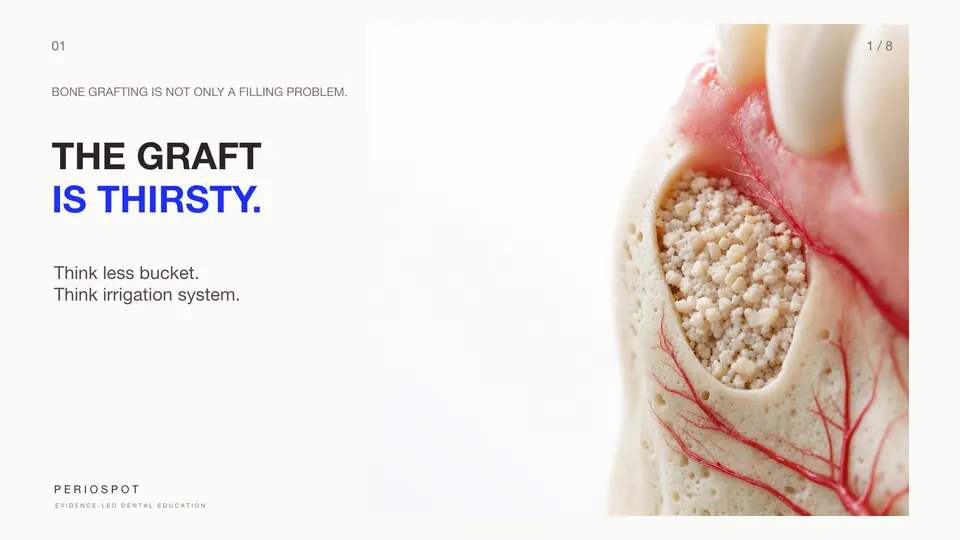
Slide 1 of 8: The graft is thirsty.
Material selection matters, but biology has to feed the graft.
Stage and Grade Periodontitis
A lecture-friendly simplification of the staging and grading logic behind the 2018 periodontal classification.
Use as a fast teaching deck before sending clinicians to the full classification criteria.
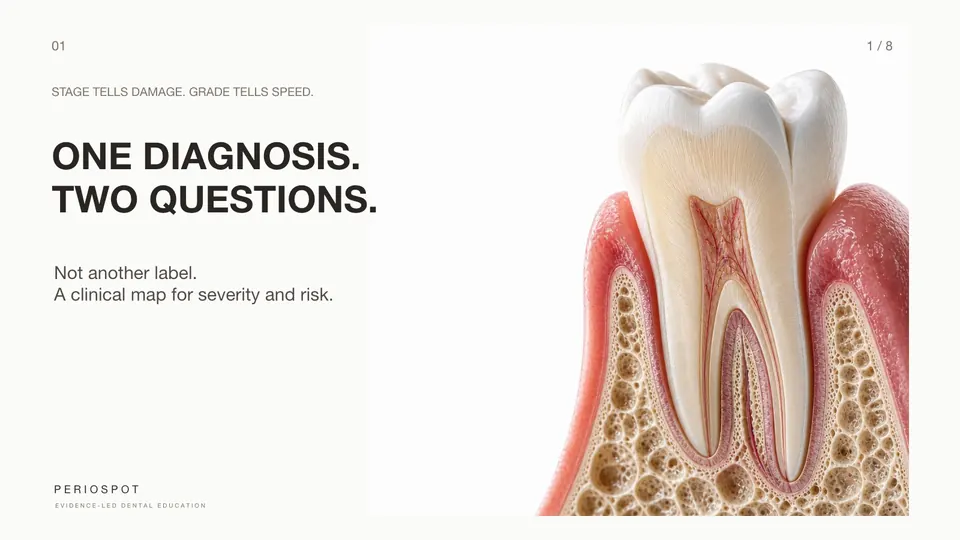
Slide 1 of 8: One diagnosis. Two questions.
Stage describes severity and complexity. Grade describes progression and risk.
Schneiderian Membrane Phenotype
A concise deck about visible gingival phenotype as a possible clue for Schneiderian membrane thickness.
Use with sinus lift planning lectures where you need a clear association-not-diagnosis guardrail.
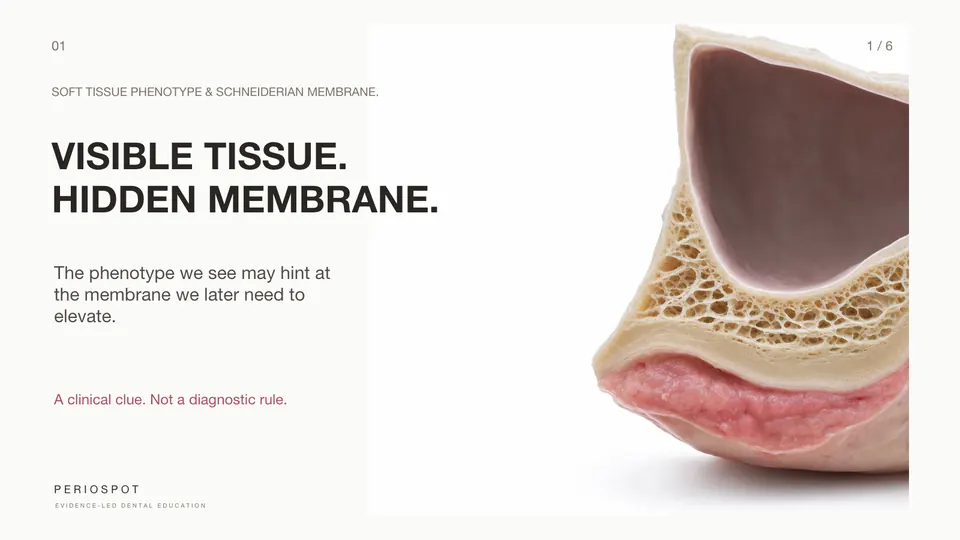
Slide 1 of 6: Visible tissue. Hidden membrane.
The phenotype we see may hint at the membrane we cannot see.
Blood Supply in Bone Grafts
A dark lecture deck about blood supply, vessel access, scaffold behavior, and why grafts need a living recipient site.
Use to move regeneration conversations away from brand names and toward biologic conditions.
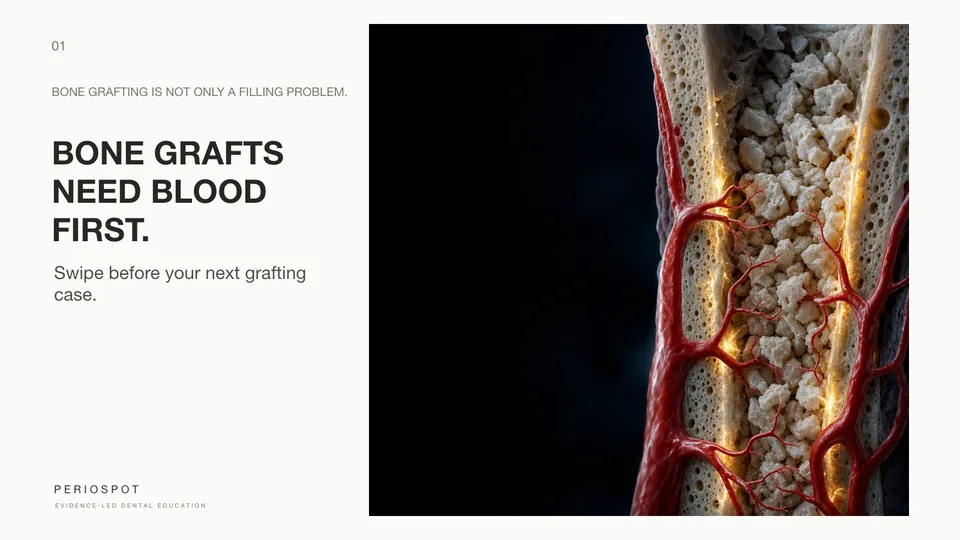
Slide 1 of 8: Bone grafts need blood first.
Scraps before your next grafting course.
Your Plaque Has a Group Chat
A Periospot dark-style deck about plaque as a living biofilm ecosystem and bacterial communication.
Use for modern biofilm lectures where the goal is stability and ecology, not sterility.
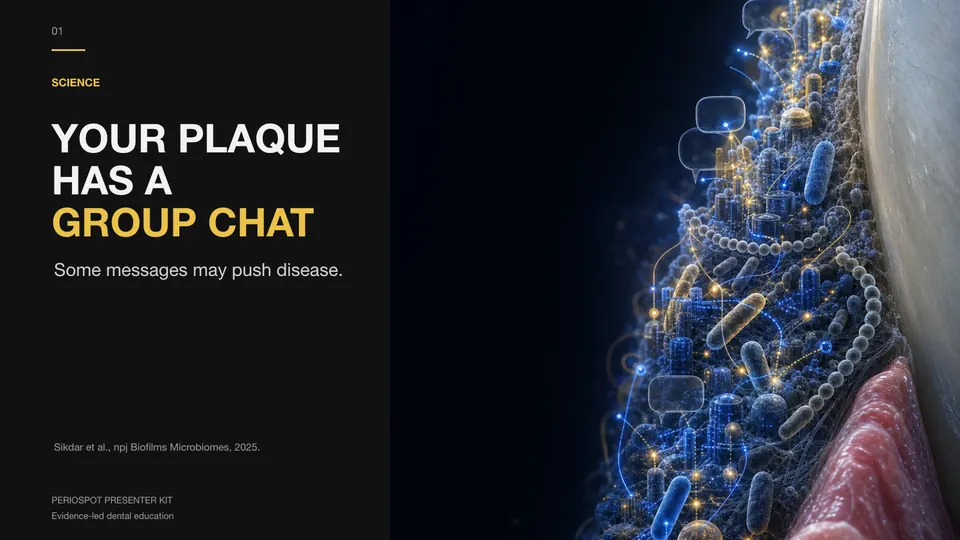
Slide 1 of 10: Your plaque has a group chat.
Some messages may push disease. Some communities stay quiet.
Smoking Meets the Implant
A risk-framing deck about smoking, peri-implant healing biology, marginal bone, and clinician communication.
Use for consent and risk modification lectures where smoking is framed as a modifiable risk, not an absolute contraindication.
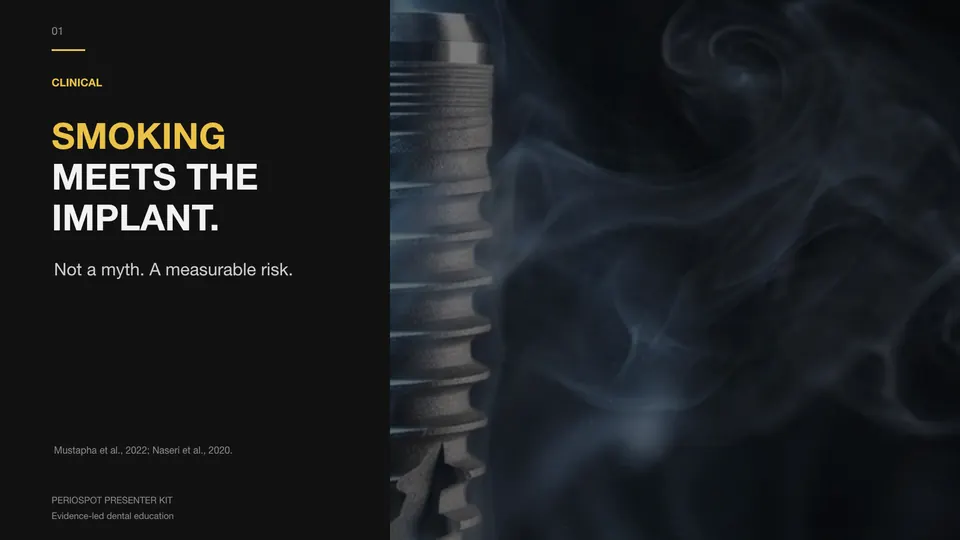
Slide 1 of 10: Smoking meets the implant.
Not a myth. A measurable risk.
Peri-Implant Phenotype Thresholds
A dark lecture deck about early phenotype variables, exploratory thresholds, and five-year peri-implant stability.
Use to teach phenotype-aware implant planning without presenting thresholds as final diagnostic rules.
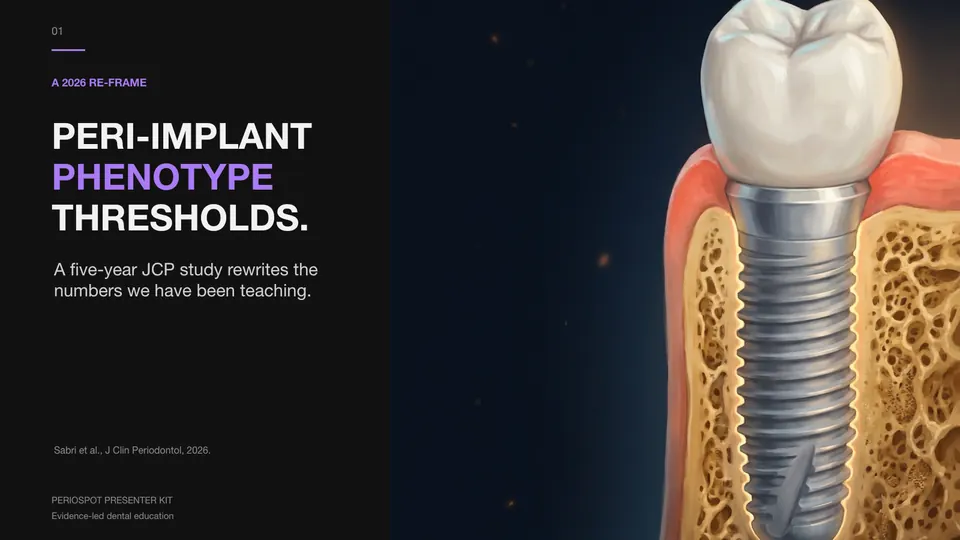
Slide 1 of 10: Stability may start before osseointegration.
Bone, soft tissue thickness, and emergence design shape the environment.
Implant Cannot Recreate the Periodontal Ligament
Editable deck on why osseointegrated implants function with a different attachment apparatus, not a recreated periodontal ligament.
Use it to explain PDL biology, collagen orientation, sensation, vascularity, and the limits of implant attachment claims.

Slide 1 of 8: An implant can replace a root.
It cannot recreate the periodontal ligament.
The Lungs Are Downstream From The Mouth
A concise oral-respiratory risk framework for vulnerable patients, preserving the evidence boundaries from the source carousel.
Teach the mouth as a microbial reservoir and aspiration-risk context without overstating causation or prevention claims.
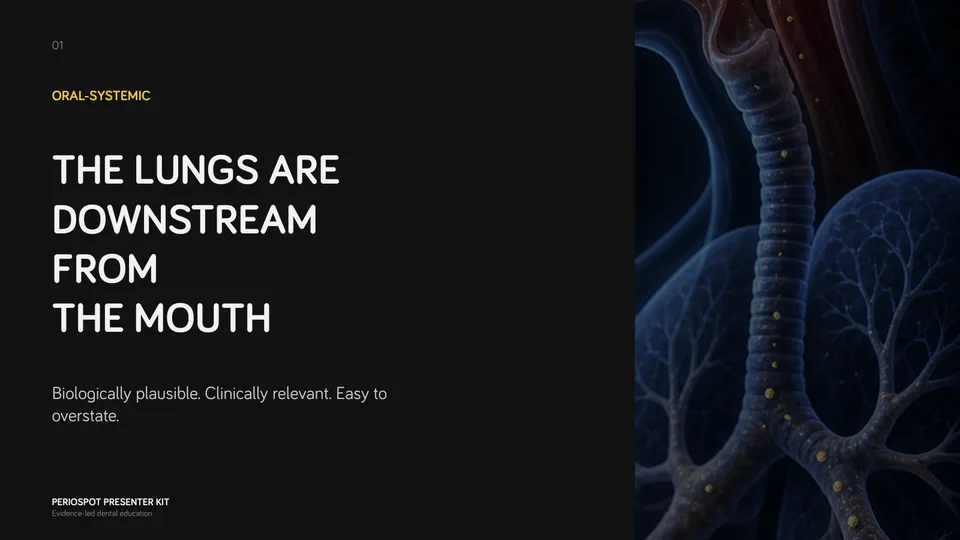
Slide 1 of 6: THE LUNGS ARE DOWNSTREAM FROM THE MOUTH
Biologically plausible. Clinically relevant. Easy to overstate.
The Body Never Meets Titanium Alone
An implant-interface biology sequence showing that osseointegration starts with surface conditioning, clotting, immune interpretation, and repair.
Move the teaching story upstream from mature bone contact to the early titanium-wound interface, while preserving the clinical boundary on surface claims.
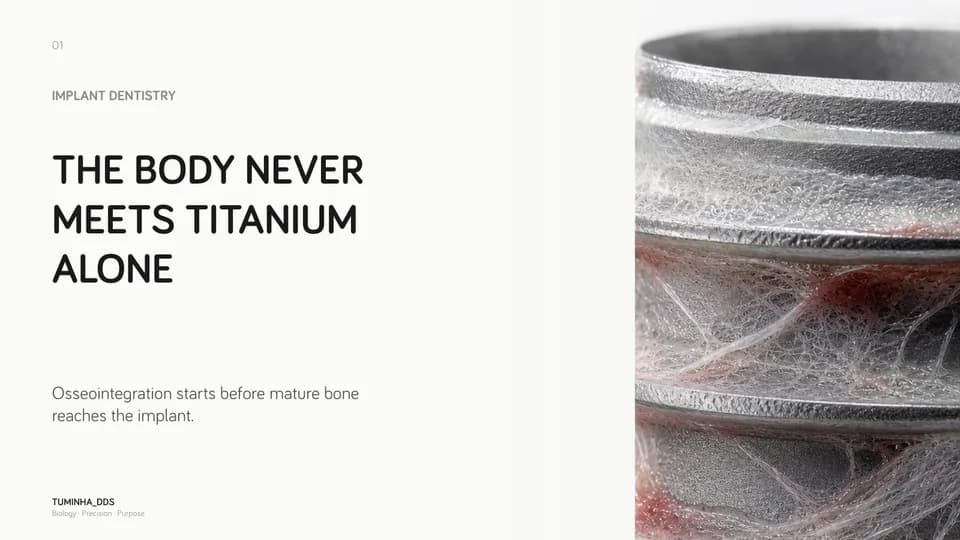
Slide 1 of 6: THE BODY NEVER MEETS TITANIUM ALONE
Osseointegration starts before mature bone reaches the implant.
One Bacterium Changed Periodontal Thinking
A conservative teaching deck on P. gingivalis, the red complex, dysbiosis and periodontal ecosystem thinking.
Use this to explain why a keystone pathogen can influence disease without making periodontitis a one-bug diagnosis.

Slide 1 of 10: One bacterium changed the room
But periodontitis is not a one-bug disease.
A Maintenance Visit Is Not Just a Cleaning
A supportive periodontal care deck on residual pockets, bleeding, and site-specific maintenance decisions.
Use during maintenance training to separate polishing from disease-responsive supportive care.

Slide 1 of 10: A maintenance visit is not just a cleaning.
The polish is the least interesting part.
Nicotine Does Not Burn the Periodontium
Nicotine-linked cellular healing and peri-implant vascular limits, with explicit source caveats.
Use nicotine exposure as a recall and risk-conversation frame without converting cell or animal data into dose-level clinical certainty.

Slide 1 of 8: Nicotine does not burn the periodontium.
It starves the healing field.
Guided Surgery Misses, By How Much?
Guided implant accuracy numbers with the 2 mm safety-margin caveat and outcome-surrogate limit.
Teach guided surgery as error reduction, not error removal.

Slide 1 of 10: Guided surgery misses. By how much?
The pooled error is at entry, apex and angle.
Periodontitis in the Fertility Conversation
A caveated oral-systemic deck on periodontitis and fertility evidence.
Keep the mouth in the preconception-health conversation without claiming causation or treatment benefit.

Slide 1 of 10: Fertility and periodontitis.
What we know. What we do not.
Cow Bone vs Lab Bone?
A preclinical GBR scaffold comparison framed as a signal, not patient-level proof.
Teach the DBBM versus synthetic-scaffold discussion with the model size and clinical limit visible.

Slide 1 of 10: Cow bone vs lab bone?
The GBR question is changing.
Titanium Needs a Living Border
Peri-implant mucosa as a living interface, with descriptive histology limits.
Move the implant biology discussion from titanium hardware to the tissue interface around it.

Slide 1 of 8: Titanium needs a living border.
Meet the peri-implant mucosa.
Gingival Phenotype and the Esthetic Zone
Gingival phenotype as measured, site-specific tissue features and a caveated esthetic risk signal.
Teach phenotype as a site-specific assessment, not a visual diagnosis or deterministic margin prediction.

Slide 1 of 7: Same smile. Different tissue.
Descriptive gingival patterns. Tissue thickness must be measured at the site.
Restoration-Driven Implant Positioning
Three-dimensional implant positioning planned from the restoration and tissue envelope.
Teach planning references as context-dependent principles, with restorative and anatomical verification.

Slide 1 of 7: The crown sets the coordinates.
Plan the restoration, then locate the implant in three dimensions.
Floss Is the Second Choice Now
Interdental brushes versus floss: what the EFP guideline, the European consensus and the Cochrane review support, with certainty caveats.
Teach interdental device choice by embrasure space and gum inflammation, not by habit, and keep the low-certainty caveats visible.

Slide 1 of 10: Floss is the second choice now.
European consensus calls the interdental brush the device of choice. Floss keeps one job, and the space decides.