How to Build a Dental Portfolio That Actually Opens Doors: A Guide from Someone Who Reviews Them


Table of Contents
In machine learning, we talk about "features" — the variables that determine whether an algorithm predicts success or failure. The more predictive the feature, the more weight it carries in the model.
Here's something I've realized after three decades in dentistry, and now sitting on the other side of the table reviewing candidates: if applying to a job was a machine learning project, your online presence would be your best feature.
Not your GPA. Not even your clinical skills (though those matter enormously). Your visible, documented, discoverable professional presence is what separates the candidates I remember from the ones I forget.
I mean it. I'm serious.
Let me explain why, and more importantly, how to build a dental portfolio that actually works — from someone who started coding HTML in Barcelona just to share clinical cases, and somehow ended up as Executive Director at the Foundation for Oral Rehabilitation.
The Origin Story You Weren't Expecting
Back in Barcelona, while I was doing my Master's degree in Implant Dentistry and Oral Surgery, I had a realization that changed everything.
I was building up a solid collection of challenging clinical cases. Complex implant placements, bone regeneration protocols, cases that taught me something new. And I thought: it's a pity that I'm creating all this work and doing nothing with it.
This was the early days of Facebook and Twitter. Social media was just becoming a thing. And I had this crazy idea: what if I created a website where I could document my cases and explain the science behind my clinical decisions?
So I taught myself HTML and CSS. I built franciscobarbosaimplantology.com (yes, terrible name — I know). But here's the thing: that "terrible" first step started everything.
From there came Periospot. Then my MBA (thanks to my wife, who told me I was "not very good at managing a business" — she was right). Then 20,000+ subscribers, ebooks with 6,000 downloads in a single week, international speaking invitations, and eventually my role at FOR.
"It's not a matter of doing it overnight but doing step-by-step and keep growing. At the end, you can end up with a huge stack of content that positions you as a brand."
The portfolio at franciscodds.framer.ai didn't happen overnight. It's the result of compounding — 10+ years of adding one case, one article, one presentation at a time.
What I See When I Review Candidates (And Why Most Portfolios Fail)

Now that I'm in the corporate dental world, I regularly review candidates for positions. Dentists who want to transition from clinical practice to industry roles. And I see the same problems over and over.
Problem #1: The "Please Reject Me" CV
Some CVs are so sparse, so generic, that they look like the person wanted to be rejected. Copy-pasted templates with nothing that tells me who this person actually is. No personality. No achievements. Just... facts that could belong to anyone.
Problem #2: Brilliant People, Zero Digital Presence
This one breaks my heart. I've interviewed candidates with phenomenal clinical skills, impressive backgrounds, great communication in person — but when I search for them online? Complete shadows on the web.
Nothing. No articles. No case documentation. No LinkedIn presence beyond a basic profile. No evidence that they've contributed anything to the profession.
"A CV alone is not enough. You need an online portfolio — a place where you start putting together your achievements and milestones."
In 2026, if you can't be found online, you effectively don't exist to most hiring managers. This isn't fair, but it's reality.
Problem #3: AI-Generated Everything
Here's a nuance many people miss: using AI to check your grammar and spelling as a non-native English speaker (like me) is fine. Smart, even.
But your CV and portfolio have to breathe about you. You are a brand. You are an entity. If everything reads like ChatGPT wrote it, you've lost the very thing that makes you memorable.
The Essential Components of a Dental Portfolio
Based on what actually impresses me (and what I've built myself), here's what your portfolio needs:
1. Clinical Case Documentation
This is non-negotiable. You need high-quality before/after photos, treatment planning rationale, and follow-up documentation.
I carry 900 slides of clinical cases on my keynote presentation. That's not showing off — that's 10+ years of documenting every interesting case I treated. This consistency is key.
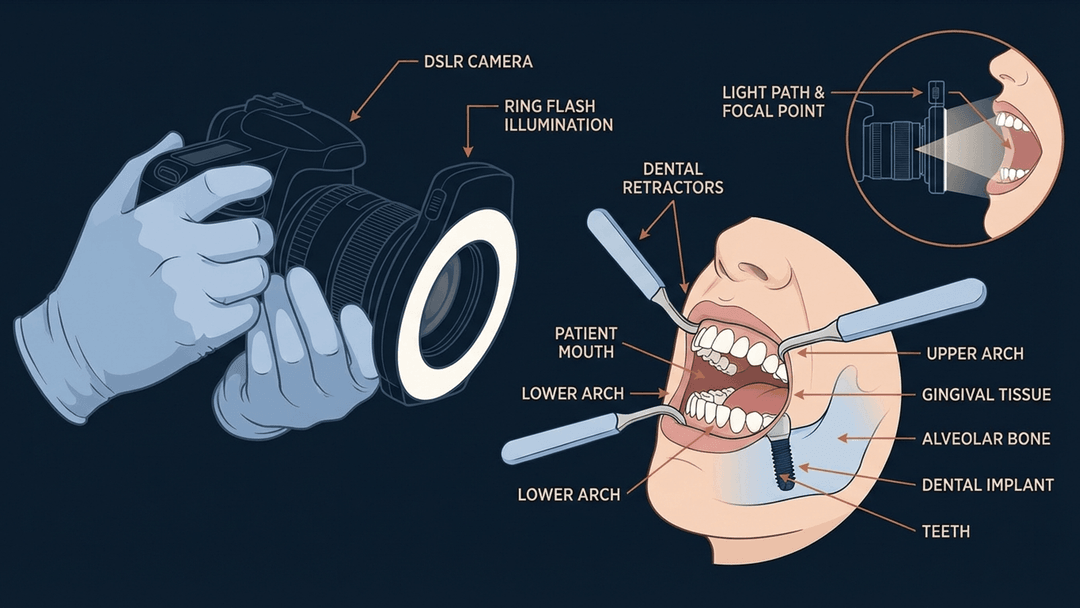
2. Dental Photography Setup
This is your first major investment after graduation. Yes, it's expensive. But without high-quality images, you cannot build a reputation. Period.
My recommendation for a complete setup (our full dental photography guide covers settings and technique in depth):
Camera Body: The Canon EOS R6 Mark II offers the resolution and autofocus performance you need for clinical documentation.
Macro Lens: The Canon RF 100mm f/2.8L Macro is the gold standard for intraoral photography.
Ring Flash: The Canon MR-14EX II provides even, shadow-free illumination essential for clinical accuracy.
Accessories: Don't forget dental photography mirrors and retractors — without proper soft tissue retraction, even the best camera won't save you.
For a complete guide on dental photography equipment, check out my detailed article on Periospot about the essential photography setup.
3. Educational Content & Publications
Ebooks, articles, videos — these demonstrate that you can synthesize and communicate knowledge. My ebooks took enormous effort (research, illustrations, animations), but nothing has positioned me better professionally.
Want to turn your own clinical content into a short video or an Instagram carousel? You can make both on Periospot, with Carousel Studio and Video Studio.
4. Your Digital Home Base
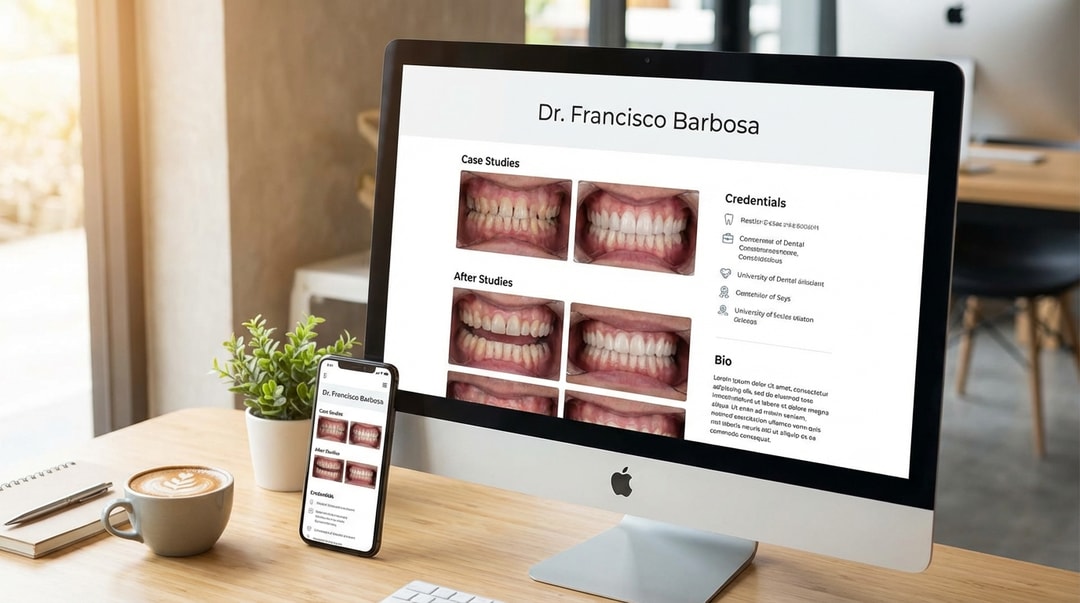
You need a single URL where everything lives. Options include:
- Framer (what I use at franciscodds.framer.ai) — beautiful, no-code, professional results
- Notion — great for content-heavy portfolios
- Personal website — maximum control, requires more effort
Your portfolio should include:
- Professional headshot
- Bio and credentials
- Best clinical cases (3-5 stellar examples beat 20 mediocre ones)
- Publications and ebooks
- Speaking engagements
- Tech stack / skills (especially relevant for industry roles)
- Contact information
5. Active Professional Presence
Your portfolio isn't just a static website. It includes:
- LinkedIn profile (optimized, not abandoned)
- Contributions to professional discussions
- Conference presentations
- Peer interactions and endorsements
The Mentor Factor
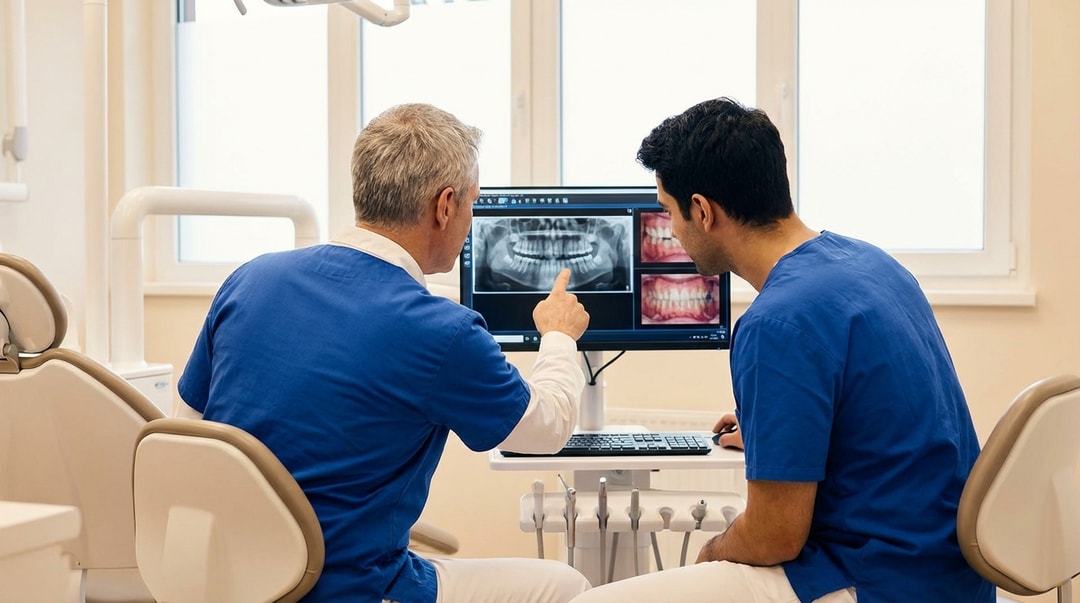
When I was starting with dental photography, I was lucky to have Nuno Gustavo, a professor of orthodontics in Barcelona, guide me on choosing my first equipment setup. He helped me avoid expensive mistakes and accelerated my learning by years.
Find your Nuno. Identify someone whose work you admire, reach out to them, and ask for guidance. Most successful professionals are willing to help — they remember when they were in your position.
"Find someone who is a reference to you, approach them, and start connecting. These people usually are really willing to help."
The Hard Truth About Shortcuts
There are no shortcuts to building a compelling dental portfolio. None.
You need to develop two things simultaneously:
1. Clinical excellence: Go to the office, perform treatments, challenge yourself with complex cases. Push your boundaries.
2. Continuous learning: Instead of Netflix, read the Journal of Clinical Periodontology or Clinical Oral Implants Research. Check what the scientific literature says about what you do daily.
Here's a sobering finding: research by Pommer et al. (2016) conducted a Delphi study with implantologists from the Austrian, German, and Swiss Societies for Implantology. They found that even when confronted with Level I meta-analytic evidence, a significant portion of clinicians did not change their treatment decisions.
Why? Because of the most dangerous phrase in dentistry: "I do this and it works for me."
Don't be that person. Let evidence guide your practice, and let your portfolio reflect your commitment to excellence.
Your First Step (Do This Today)
If you're a dental student or early-career dentist reading this, here's what I want you to do today:
Start documenting. Your next interesting case? Photograph it properly. Write up what you did and why. Even if no one sees it yet, you're building the raw material.
Create your LinkedIn profile if you don't have one, or update it if it's gathering dust.
Register a domain with your name. You don't need to build the site today, but secure your digital real estate.
Find one mentor whose work you admire. Send them a message. The worst they can say is nothing.
The portfolio you build over the next decade will determine doors that open (or stay closed) for the rest of your career. Start now.
Recommended Reading
If you want to go deeper on personal branding and professional positioning:
📚 Building a StoryBrand by Donald Miller — Understanding how to position yourself as the guide in your career narrative.
📚 Essentials of Dental Photography — The technical foundation for clinical case documentation.
Final Thought
An implant system is like a boyfriend: if you don't know him very well, he may cause you lots of problems.
Your portfolio is similar. If you don't invest the time to really know what you're building — your brand, your story, your documented excellence — it won't work for you when you need it most.
Start today. Document everything. Compound over time. And remember: you're not just building a portfolio. You're building a career.
What's your experience building a professional portfolio? Have questions about getting started? Leave a comment below or reach out — I'd love to hear from you.
Bibliography
Pommer, B., Becker, K., Arnhart, C., Fabian, F., Rathe, F., & Stigler, R. G. (2016). How meta-analytic evidence impacts clinical decision making in oral implantology: a Delphi opinion poll. Clinical Oral Implants Research, 27(3), 282-287. https://doi.org/10.1111/clr.12528
Tarnow, D. P., Cho, S. C., & Wallace, S. S. (2000). The effect of inter-implant distance on the height of inter-implant bone crest. Journal of Periodontology, 71(4), 546-549.
Albrektsson, T., Zarb, G., Worthington, P., & Eriksson, A. R. (1986). The long-term efficacy of currently used dental implants: a review and proposed criteria of success. International Journal of Oral & Maxillofacial Implants, 1(1), 11-25.
Comments
0 totalLoading comments...
Previous
How to Build Your Dental Photography Portfolio
Next
Immediate Implant Placement: The 2025 Evidence-Based Guide for Clinical Success
Related Articles
Dental KOL Marketing: How Implant and Periodontal Brands Build Their Key Opinion Leader Bench
11 min read
Dental Video Marketing: How Brands Use Clinical Video to Drive KOL Adoption
12 min read